/Logos/Ardoq/RGB_Ardoq_Logo_Primary_Purple.svg)
2026 is already shaping up to be a pivotal year for Enterprise Architecture.
Across the industry, one thing is becoming clear: AI is fundamentally changing how architecture teams operate. Architects are no longer just documenting the IT landscape. They are increasingly responsible for helping organizations reason through complexity, guide transformation, and govern the growing wave of AI systems entering the enterprise.
The signals from the market are strong. CEOs overwhelmingly believe AI will reshape their industries, while EA leaders are being asked to move faster and support more strategic decisions with fewer resources. At the same time, many architecture teams are discovering a hard truth: traditional EA deliverables were never designed for an AI-driven world.
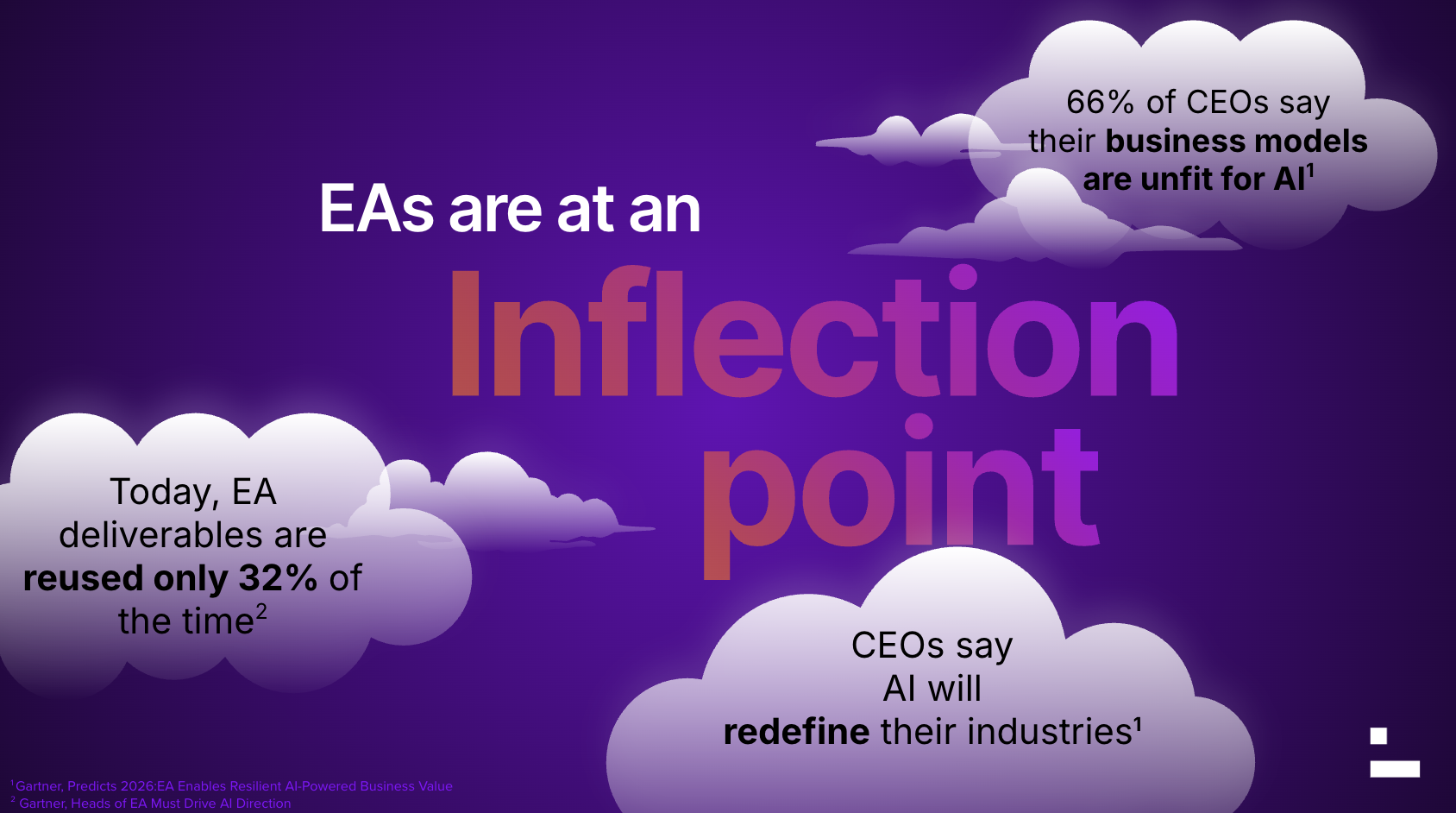
To operate effectively in this new environment, Enterprise Architecture must evolve. Keyshifts are becoming increasingly clear:
- Architecture must become machine-readable.
AI systems need structured context to reason effectively. Static diagrams and disconnected documentation cannot support AI-driven decision making. - Architecture must support faster decision cycles.
Executives are asking architecture teams not just for visibility, but for prioritization, trade-off analysis, and transformation guidance. - Architecture must govern AI itself.
As organizations experiment with AI agents, copilots, and automation, architects are becoming central to ensuring these systems are deployed responsibly and aligned with business strategy.
At Ardoq, these shifts are shaping how we build our platform. Our vision is to move EA beyond documentation and toward AI-powered decision intelligence. This means combining a living enterprise knowledge graph with AI capabilities that help architects explore data, uncover patterns, and guide transformation decisions with greater confidence.
Jump to:
- How We’re Innovating: The Ardoq AI Hackathon
- Real-World Impact at Tenneco: How Ardoq and AI Supports EA Teams
- Ardoq’s AI Innovations in Q1 2026
How We’re Innovating: The Ardoq AI Hackathon
 Innovation rarely happens in isolation. Earlier this quarter, we hosted an internal AI Hackathon, bringing together engineers, architects, and product teams to explore new ways AI could enhance enterprise architecture workflows. The goal was simple: experiment with bold ideas and learn quickly.
Teams explored concepts such as:
- AI-driven architecture insights
- Agent-based architecture assistants
- Automated architecture data quality detection
- New ways to query and explore architecture knowledge using natural language
Some of these experiments will evolve into future product capabilities. Others help us better understand how AI can support real-world architecture work.
What matters most is the learning.
Hackathons allow us to challenge assumptions, test ideas rapidly, and push the boundaries of how AI can improve the practice of Enterprise Architecture.
Many of the innovations we launched this quarter were shaped by that same spirit of experimentation.
Read more about what we learned in our AI Hackathon or see what other AI capabilities we’re experimenting with at Ardoq Labs.
Real-World Impact at Tenneco: How Ardoq and AI Supports EA Teams
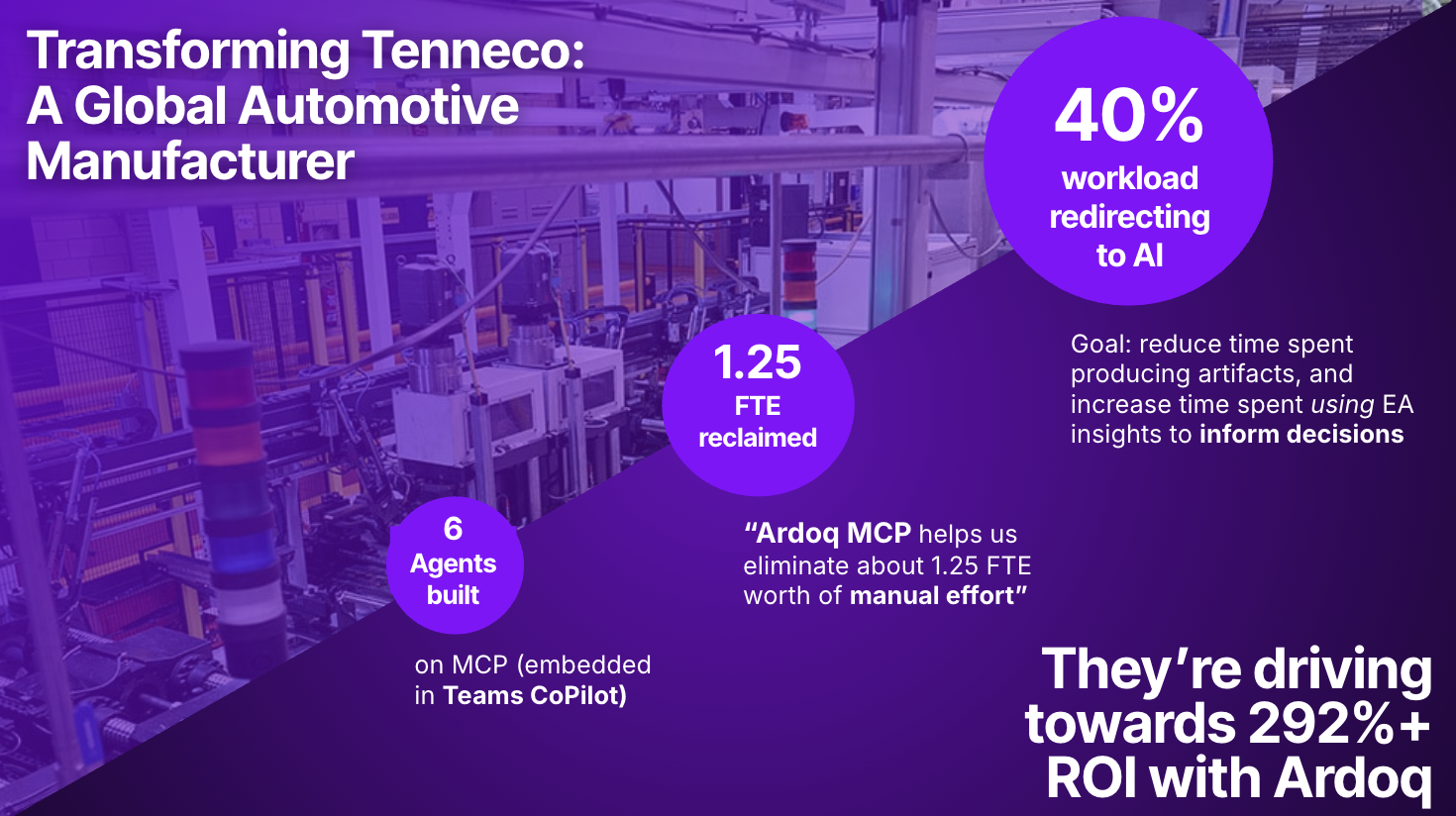
We are already seeing organizations use AI to reduce manual effort and redirect their time toward higher-value architectural work.
One example comes from global automotive manufacturer Tenneco, which uses Ardoq’s MCP integration to enable conversational access to architecture data.
Their team estimates that AI-assisted workflows eliminate roughly 1.25 FTE of manual effort, allowing architects to spend significantly more time applying architecture insights rather than producing artifacts.
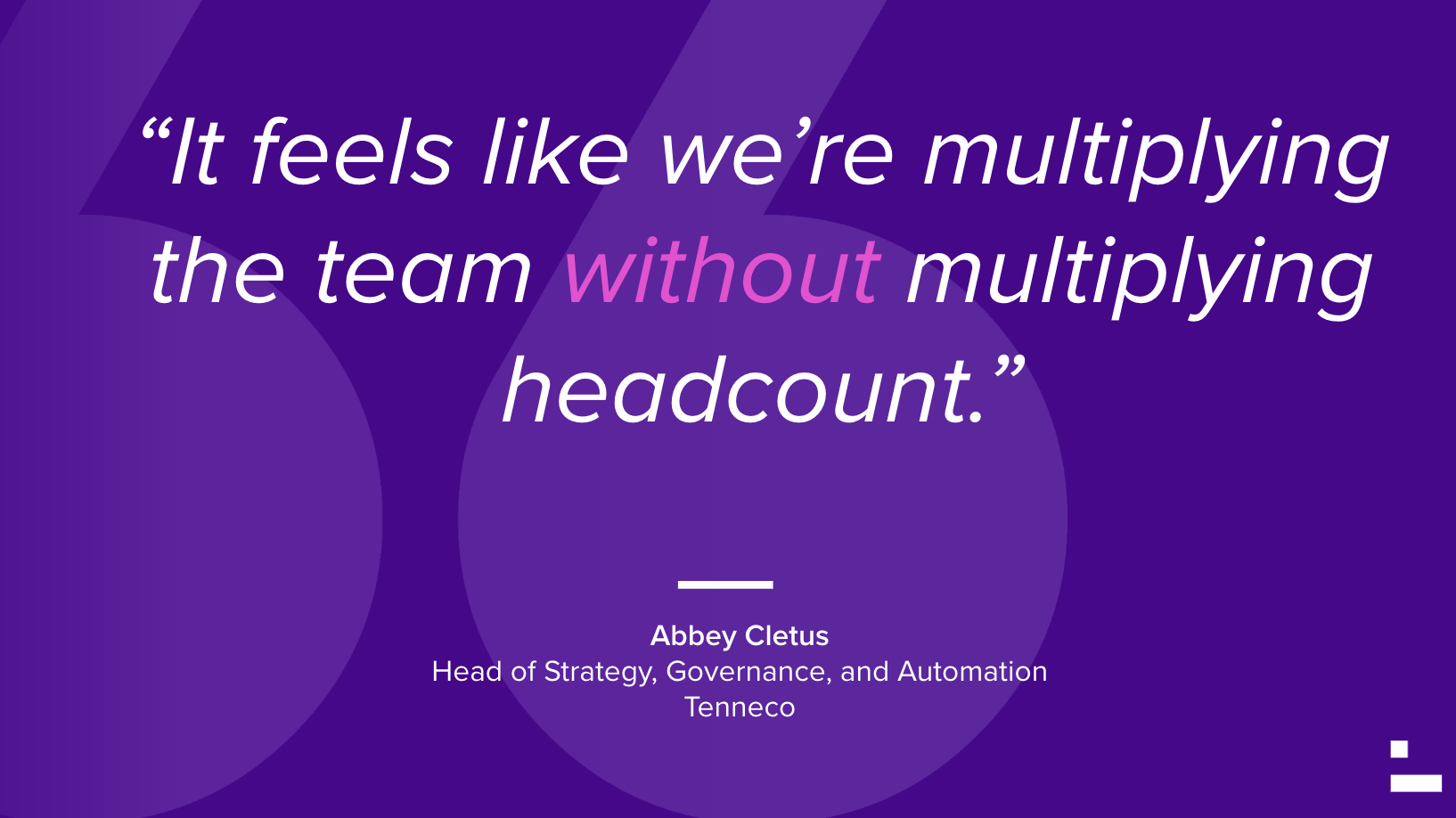
This shift is exactly what we believe AI should enable: helping architecture teams focus less on documentation and more on strategic decision-making.
Watch our fireside chat with Abby on the advances his team has made thanks to Ardoq.
Ardoq’s AI Innovations in Q1 2026
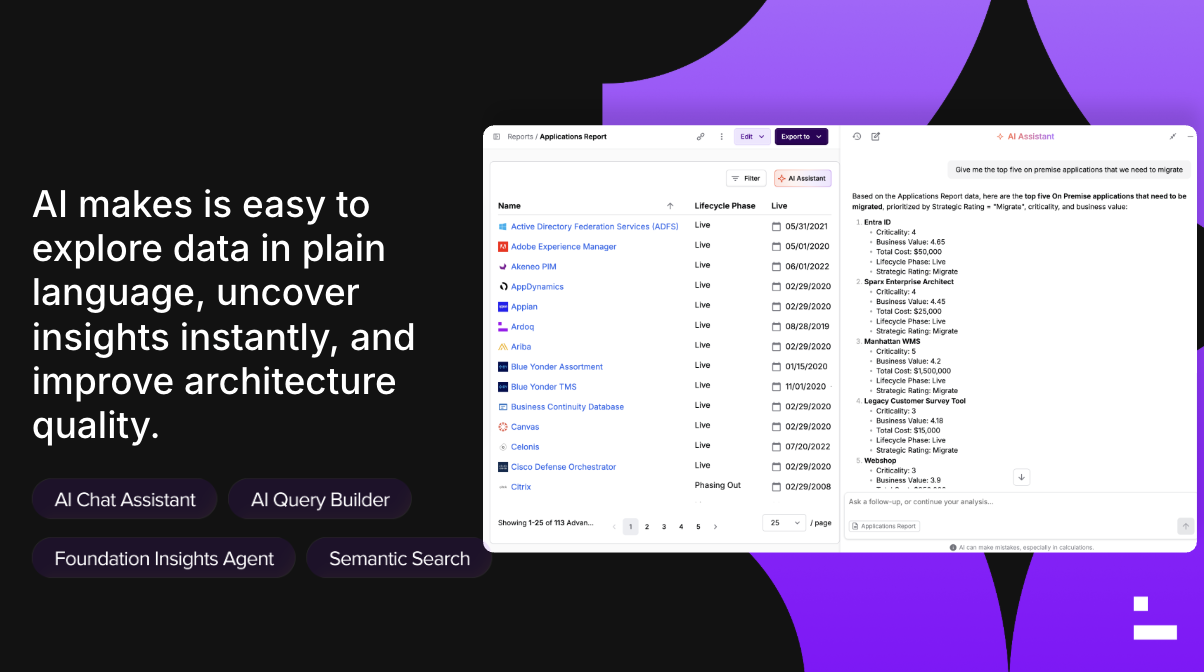 In Q1 2026 alone, we introduced several new capabilities designed to make enterprise architecture data easier to capture, explore, and reason with. Rather than isolated features, these innovations fall into three key themes that are shaping the future of AI-powered Enterprise Architecture.
Theme 1: Conversational Architecture
Architects often spend time navigating reports, views, and dashboards to answer questions about systems, dependencies, or transformation initiatives.
This quarter, we took a major step toward making architecture knowledge more accessible with the general availability of the Ardoq AI Chat Assistant.
The Chat Assistant allows users to explore their architecture using natural language questions such as:
- Which applications support this capability?
- What systems depend on this platform?
- What happens if this application is retired?
Instead of navigating complex views, architects and stakeholders can simply ask. When we transitioned the Chat Assistant from Beta to General Availability, we introduced several major improvements:
- Enhanced accuracy
Ensuring AI responses match underlying report data precisely, with significant improvements to quantitative analysis on Ardoq data - Improved reasoning and transparency
In order to assure transparency and enable users to validate the AI’s answers, we introduced a detailed reasoning chain for every AI-generated response. - Persistent chat history
Allowing users to investigate complex architecture questions over time, with previous conversations easily accessible and searchable. - Full accessibility through the new Discover Experience
Making conversational architecture insights available to a broader set of contributors.
The result is a more intuitive way for organizations to interact with their architecture knowledge.
Theme 2: Making Architecture Data Easier to Capture
One of the biggest barriers to effective EA is simply getting architecture knowledge into a structured system.
Many organizations still capture architecture insights in diagrams, whiteboards, and slide decks. While useful for communication, these artifacts rarely translate directly into structured architecture data.
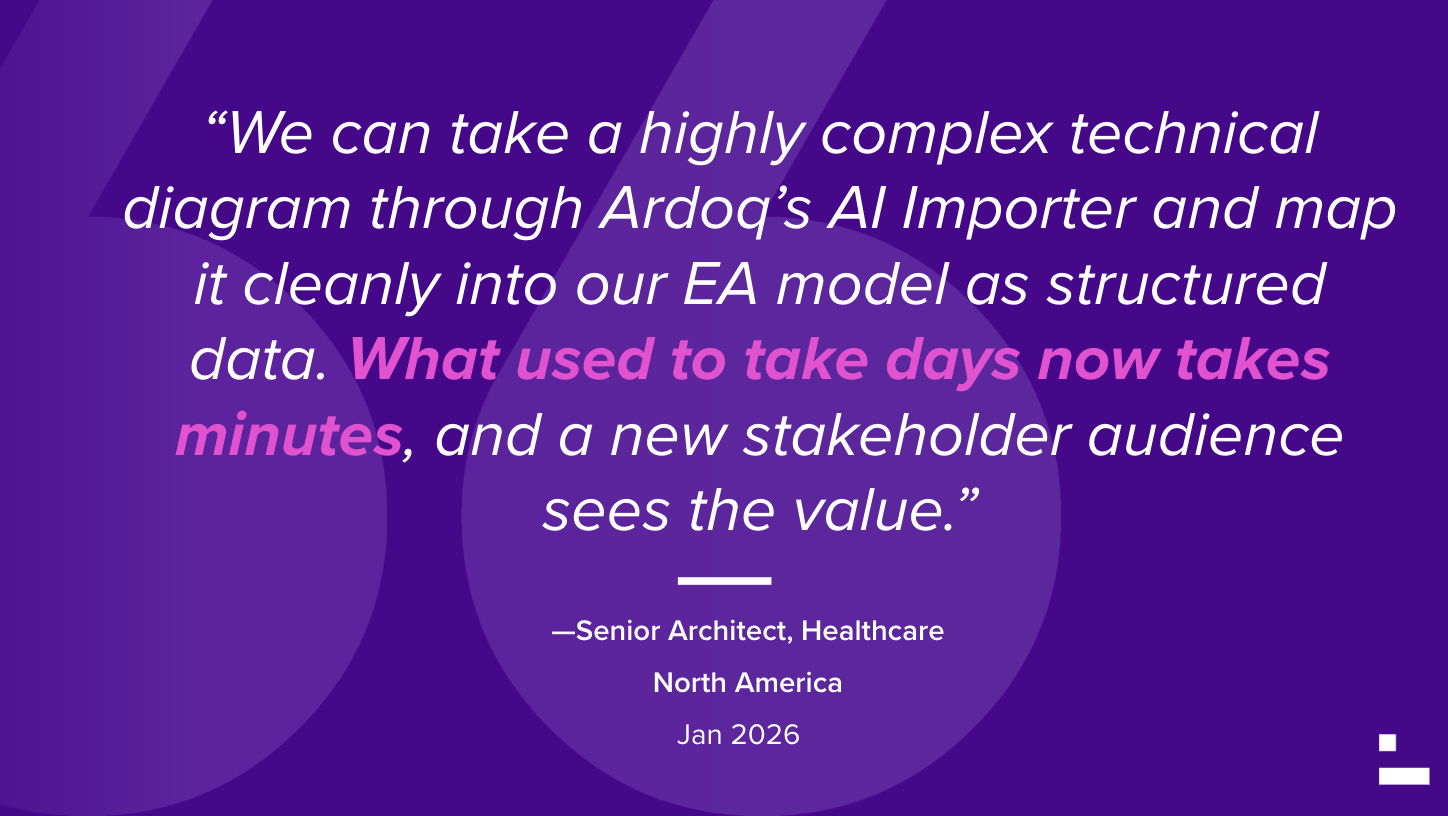
This quarter, we introduced the general availability of the Ardoq AI Visual Importer.
The AI Visual Importer analyzes diagrams, whiteboards, and other visual artifacts and converts them into structured architecture data inside Ardoq.
Using AI, the system can automatically detect:
- architecture components
- relationships between systems
- hierarchical structures
This data can then be imported into a Scenario, allowing teams a controlled space to review, refine, and validate updates before they reach mainline.
What once required hours of manual modeling can now happen in minutes.
More importantly, it ensures that valuable architecture knowledge captured in visual formats becomes part of a living architecture repository that supports analysis, decision-making, and governance.
Theme 3: Smarter Discovery and AI-Powered Insights
 As architecture datasets grow, finding the right information quickly becomes increasingly difficult. To address this challenge, we introduced three major AI capabilities designed to improve architecture discovery.
AI Auto-Discovery for Enterprise AI Systems (Now Available)
One of the biggest challenges organizations face today is understanding where AI is actually being used across the enterprise.
AI agents are being created across platforms like Google Vertex AI, Microsoft Foundry, and Amazon Bedrock, often outside the visibility of architecture teams. This creates a growing risk: AI systems operating without governance, context, or oversight.
With the general availability of Import Builder, Ardoq now enables automated discovery of enterprise AI systems and agents.
Import Builder connects directly to third-party platforms via standard APIs and continuously pulls structured data into the architecture graph. When combined with the AI Lens Solution, this allows organizations to:
- Automatically discover AI agents and systems across their technology landscape
- Bring those agents into a governed architecture model without manual effort
- Classify AI systems alongside applications, capabilities, and data flows
- Understand how AI is connected to the rest of the enterprise
This turns what is often a fragmented and invisible AI footprint into something structured, traceable, and governable.
Rather than relying on manual documentation or one-time assessments, architecture teams can now maintain a continuously updated view of AI across the enterprise.
Curious how it works? Check out this use case connecting Import Builder with Google Vertex AI.
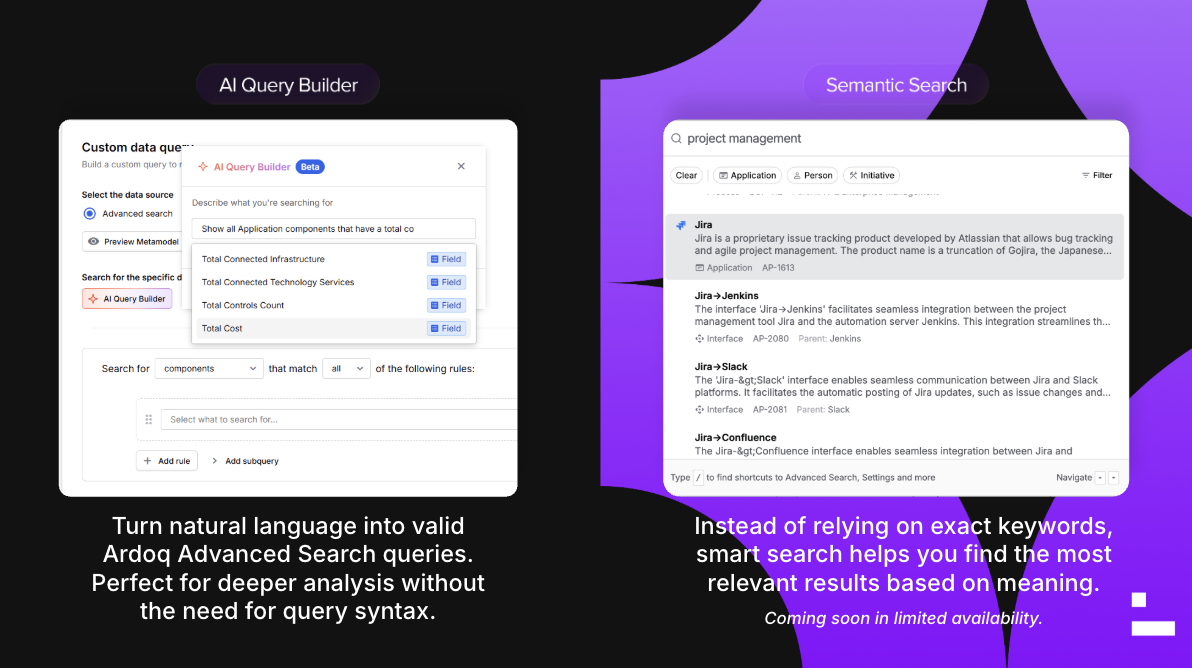
AI Query Builder (Open Beta)
The new AI Query Builder lets users create advanced architecture queries in plain language.
Instead of learning complex query syntax, architects can simply describe what they want to find. Ardoq automatically translates the request into a valid advanced search query.
This significantly lowers the barrier to entry while enabling faster insight discovery.
Semantic Search (Limited Availability)
We also introduced a new generation of semantic search, allowing users to find architecture information based on meaning rather than exact keywords.
This makes it easier for both architects and business stakeholders to locate relevant systems, capabilities, or people —even when they do not know the exact terminology used in the model.
Together, these capabilities make architecture knowledge more accessible, searchable, and actionable across the organization.
Limited Availability means this feature will be rolled out gradually to eligible customers during Q2 2026.
Building Trusted AI for EA
As AI becomes embedded in enterprise systems, trust and governance become essential.
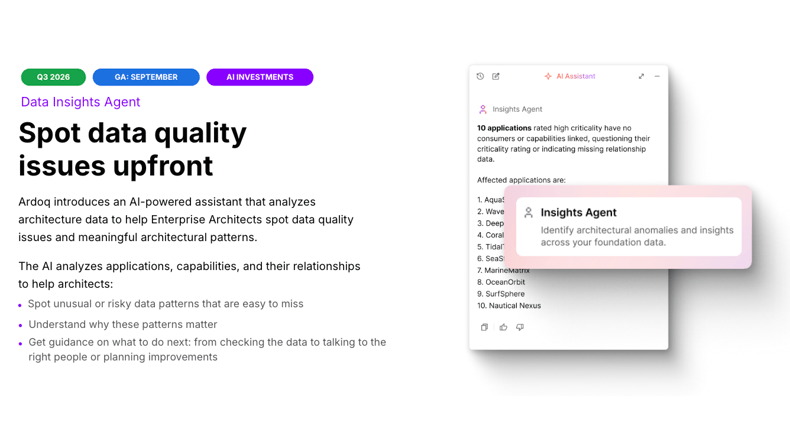
This quarter, we also laid the groundwork for a new capability called the Data Insights Agent, which will proactively analyze architecture data to identify potential risks and data quality issues.
Rather than waiting for problems to surface, this capability helps architects pre-emptively detect patterns such as:
- Data quality issues, such as missing fields
- Missing or inconsistent architecture relationships
- Unusual structural patterns in large datasets
- Hidden architecture risks
Behind the scenes, we also strengthened the infrastructure supporting AI in Ardoq.
This includes improvements to our AI evaluation framework and model infrastructure designed to ensure consistent, reliable, and accountable AI outputs.
The Bigger Picture: From Architecture Data to Decision Intelligence
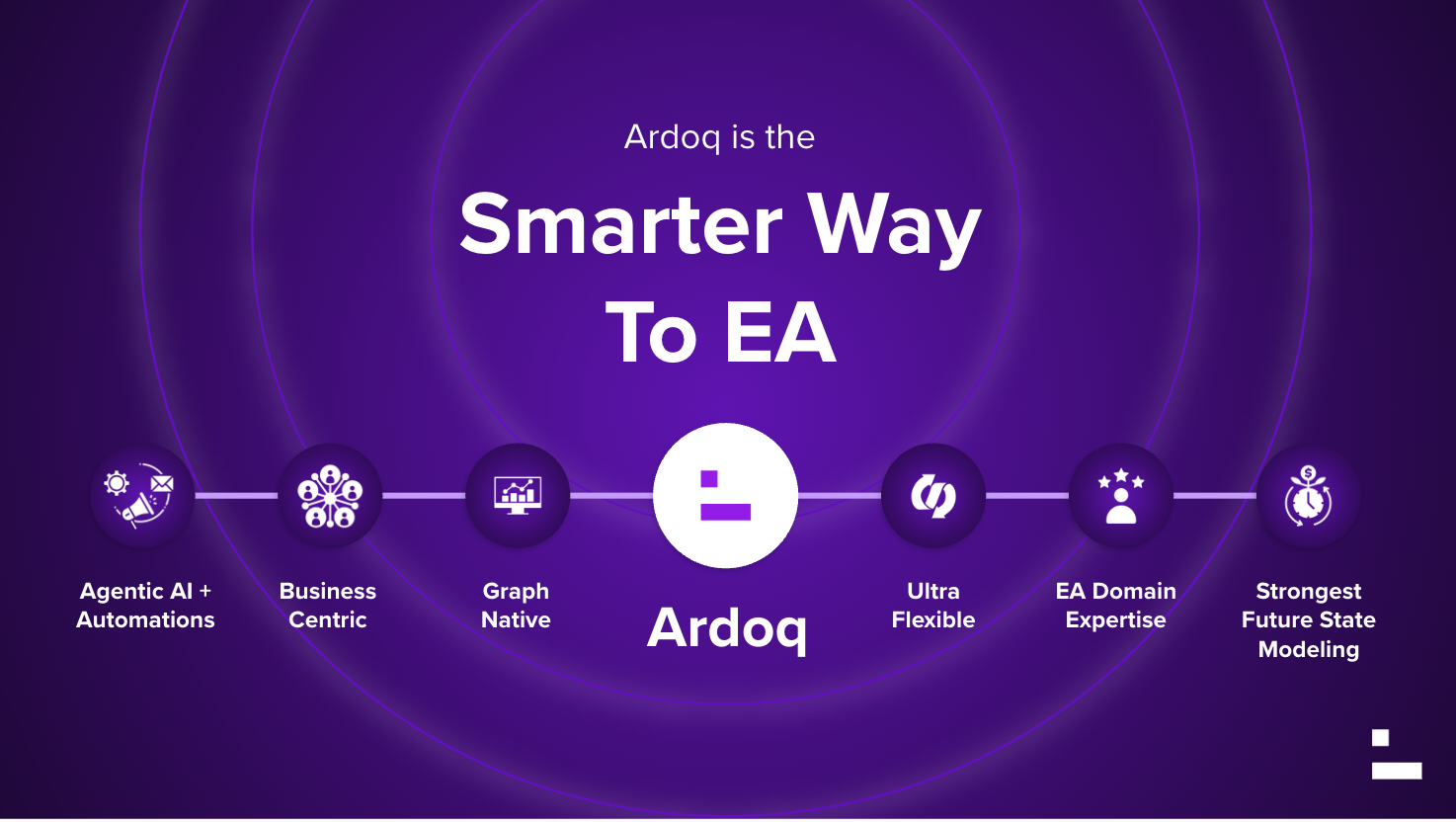
The features we launched this quarter are part of a much larger shift. Enterprise Architecture is evolving from a documentation discipline into a decision support capability for the enterprise.
By combining a graph-native enterprise knowledge model with AI-powered analysis, organizations can move from simply understanding their architecture to actively using it to guide transformation.
This means enabling architects to:
- Uncover hidden dependencies
- Evaluate trade-offs between technology investments
- Simulate the impact of transformation initiatives
- Guide leadership decisions with greater confidence
In other words, Enterprise Architecture becomes not just a system of record, but a system of intelligence for the enterprise.
Looking Ahead
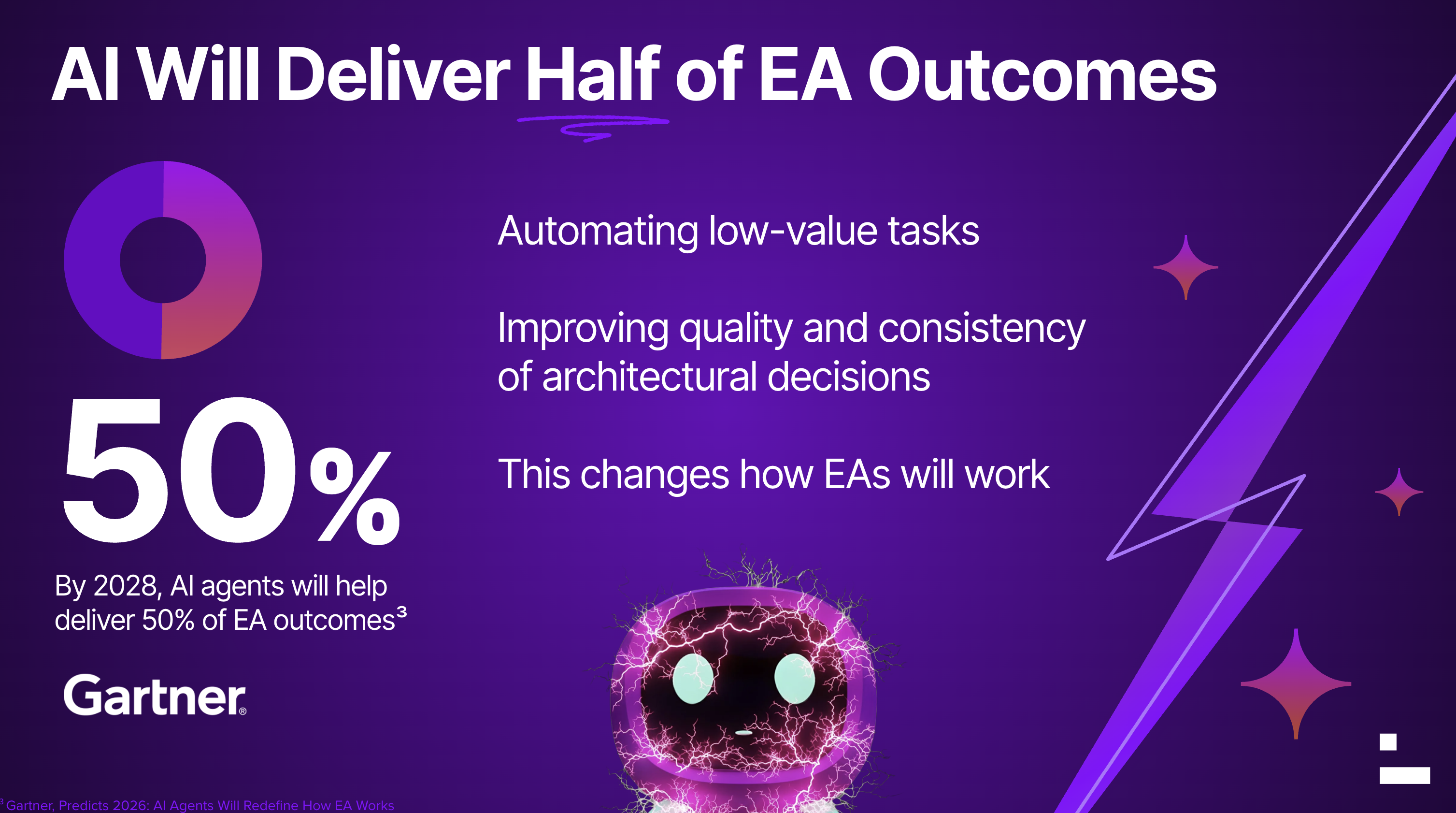
The pace of innovation in AI is accelerating, and Enterprise Architecture is becoming a critical foundation for organizations navigating this transformation.
The capabilities we introduced in Q1 represent important steps toward a future where architecture data is continuously updated, deeply connected, and augmented by AI.
Looking ahead, we will continue investing in areas such as:
- Proactive architecture insights
- Agent-assisted modeling and data population
- AI-guided prioritization and decision support
- Deeper automation of architecture workflows
Our goal is simple: help architects spend less time documenting the enterprise and more time helping organizations understand complexity and act with confidence.
- Blog Posts Innovation Highlights: Ardoq’s 2026 AI Hackathon Uncovering Shadow AI: AI Agent Discovery With Ardoq
- Webinars Top 10 AI Capabilities EAs Will Rely on in 2026: Live Demo Edition AI Governance in Practice: How Enterprise Architects Govern AI Agents & Systems with Confidence
- Playbooks Prompt Engineering for Enterprise Architects: The Conversational AI Playbook

/Logos/Ardoq/RGB_Ardoq_Logo_Stacked_White_Monochrome%201.png?width=80&height=77&name=RGB_Ardoq_Logo_Stacked_White_Monochrome%201.png)