/Logos/Ardoq/RGB_Ardoq_Logo_Primary_Purple.svg)
Eight new AI teammates built to do the EA grind, so your team can spend that time on the decisions instead.
If you're an Enterprise Architect (EA), you already know where your week goes. Building a stakeholder map before a big rollout. Tracing what breaks if one system goes down. Chasing down application owners for information locked in contracts. Rereading a 40-page contract to find the renewal date. That work matters, but it eats hours that should go to the decisions only you can make.
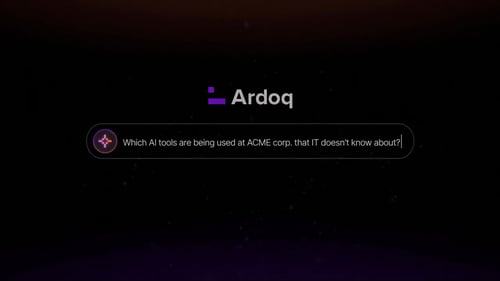
This quarter, Ardoq is rolling out eight new Architecture Agents built to take that work off your plate. Not another chatbot that answers questions about your architecture. Eight specialists that do the actual analysis: they trace dependencies, draft models, read contracts, and hand you a first draft or a clear answer, grounded in your real architecture data.
We'll go through what each agent is built for, how it works, and whether it's live today or still in beta. For a deeper read on each of these agents: AI Custom Agents.
For the bigger picture on everything Ardoq shipped in AI this quarter, read our Q3 2026 AI Innovation Roundup or our blog on the 10 Ways The Ardoq AI Assistant Just Got a Whole Lot Smarter.
Why You Can Trust What Our Agents Tell You
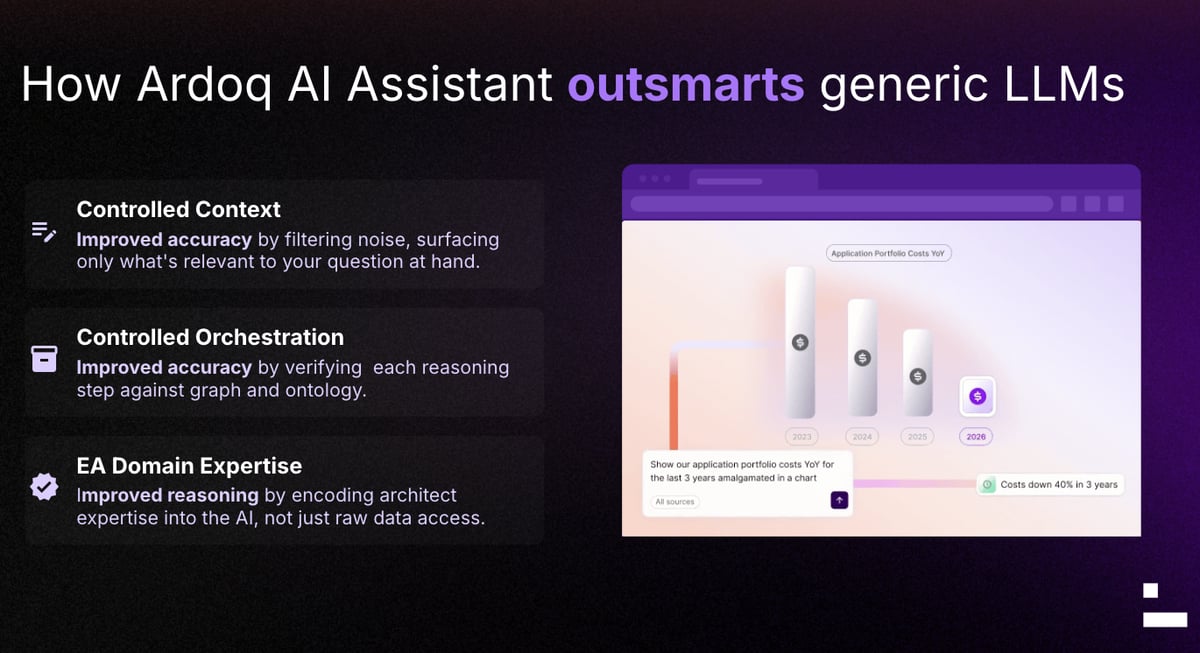
Agents are only as good as the data and rules behind them.
Every Architecture Agent runs on Ardoq's knowledge graph, the connected model of your applications, capabilities, processes, and the relationships between them, all shaped by your organization's own metamodel (the rules that define what those things mean and how they connect). That's different from a general AI chatbot, which just predicts the next likely word based on patterns. An Ardoq agent uses predefined skills specific to the EA domain, plus a rules-based symbolic layer, to ground its own reasoning in your actual data and your metamodel's definitions before it hands you an answer.
That's what makes the answers traceable, auditable, and defensible. When someone asks "how do you know that," you already have the answer: the exact field, component, and data point behind it, a click away. That's a very different conversation than "the AI said so."
Learn more about how our AI capabilities are built different to deliver answers you can trace and trust: How Ardoq's AI Assistant Outsmarts Generic LLMs
Insight and Resilience: Catch Risk Before It Becomes a Crisis
These three agents dig through your architecture so you don't have to, surfacing risk and context that used to take days to find by hand.
Disaster Recovery Blast Radius Agent (GA)
The job it replaces: Manually chasing dependencies across spreadsheets and tribal knowledge to figure out what breaks if a system goes down, usually after it's already down.
How it works: Ask the agent what happens if a given application fails, and it maps the capabilities, org units, and dependencies behind it, then stress-tests the DR plan itself. For example, when asked about Payment Services, it showed that the application supports three business capabilities across two organizational units, then returned four ranked findings: a four-hour recovery time against a two-hour tolerance, a DR plan last tested eighteen months ago that failed, an undocumented manual workaround, and a dependent system, the fraud detection engine, with no DR plan of its own. One question, four gaps, before any of them turn into actual downtime for the business.
Data Insights Agents (GA)
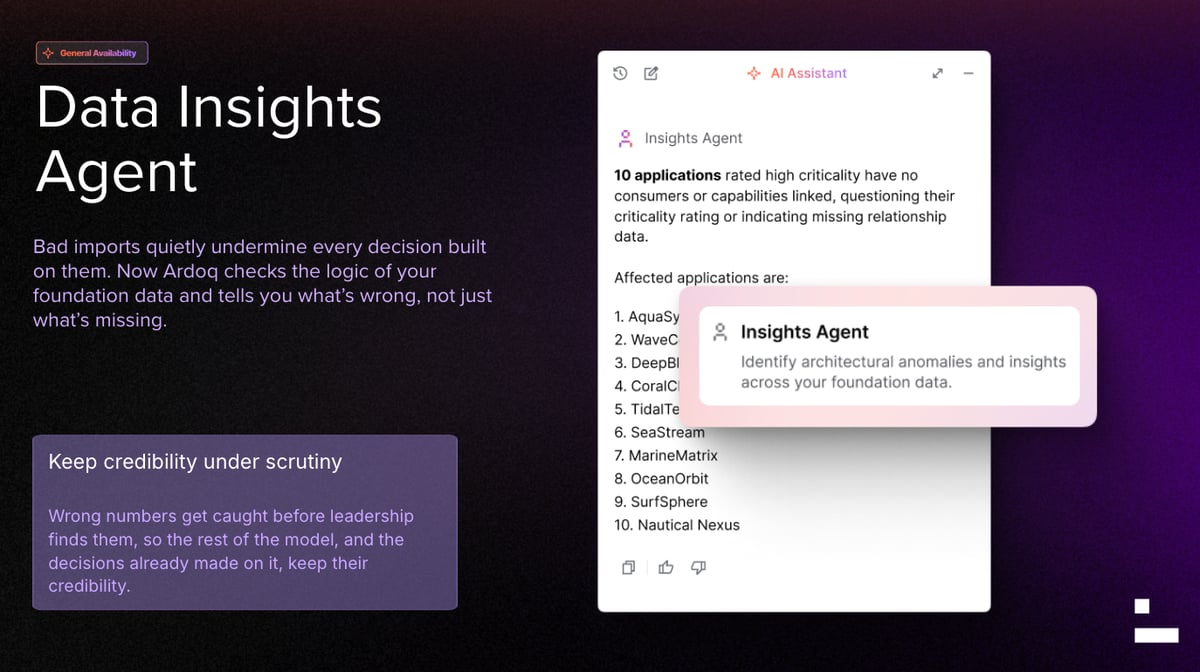
The job it replaces: Manually auditing your architecture data for quality problems and hidden risks, the kind of issue nobody notices until it has already caused a bad decision.
How it works: This is an expansion of the former Foundation Insights Agent. It proactively checks the logic of your data, not just whether fields are filled in, and tells you what's actually wrong: contradictions, gaps, and risks you'd otherwise catch only after leadership already built a decision on bad numbers. It's relaunching this quarter as a set of agents you can run individually. We're currently building toward a complete agent orchestration workflow.
Component Overview Agent (Beta)
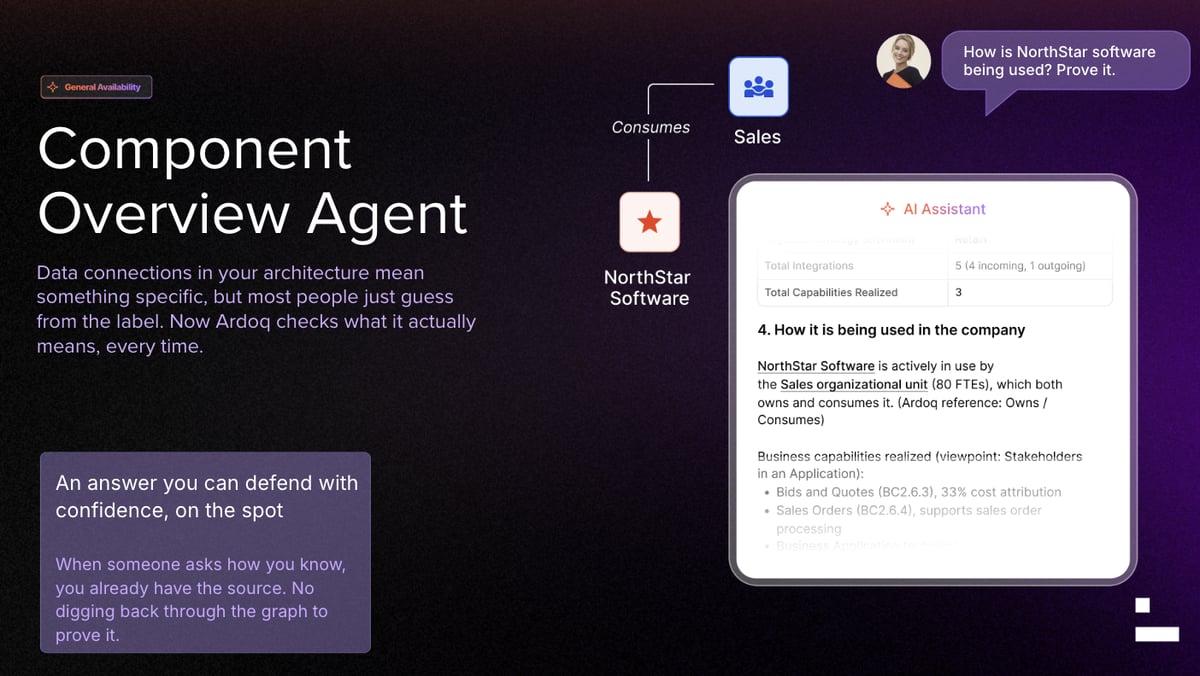
The job it replaces: Pulling a component's fields and relationships by hand, checking your metamodel to interpret them correctly, and separately researching vendor context online, with no guardrail against blending internal fact and web guesswork.
How it works: Ask about any component and the agent builds a source-attributed overview in one pass. It pulls the fields and relationships from Ardoq, applies your metamodel's definitions before interpreting anything, and adds web-sourced vendor context for known technologies, clearly labeled as external. For example, when asked for an overview of the Snowflake application, it returned that it's a data warehouse technology with four connected applications, two owned by the Data Platform team, plus vendor context pulled from the web. It's shipped in beta today, with general availability coming this quarter.
Architecture Modeling: Draft the Essential Models You Never Have Time to Build
These three agents build the maps and models architecture teams know they need but rarely have the time, or the stakeholder buy-in, to build from a blank page.
Stakeholder Map Agent (GA)
The job it replaces: Running workshops and chasing people down to figure out who owns, uses, or is accountable for a system, instead of starting from the architecture data you already have.
How it works: Ask who has power and interest over a given initiative, and the agent analyzes the application, capability, and process data already in Ardoq to draft the map, including each person's management chain, not just the listed owner. For example, when asked about a SAP migration initiative, it returned 14 stakeholders, including a CFO flagged with high power and high interest, ready for review before anything is saved. It's only finalized once you've signed off on its proposal, so the agent gives you a faster, data-grounded starting point instead of a blank canvas. It shipped as beta earlier this quarter and is now in general availability.
Value Stream Mapping Agent (Coming Soon Q4)
The job it replaces: Building a value stream from a blank canvas, which most teams don't have the time or stakeholder buy-in to do, then trying to link that value back to your capability model with no clear way to prove the connection.
How it works: Based on the data in Ardoq, it generates a single value stream for the organization as a whole, typically six to eight stages tailored to your industry, with each stage linked to the capabilities that deliver it. What used to take days of manual modeling takes minutes, and it lands in a Scenario so your team can review and refine it before anything merges into your live model. This new agent replaces our previous AI-driven value stream augmentation. It's in beta now, heading toward general availability.
App to Capability Management Agent (Coming Soon Q4)
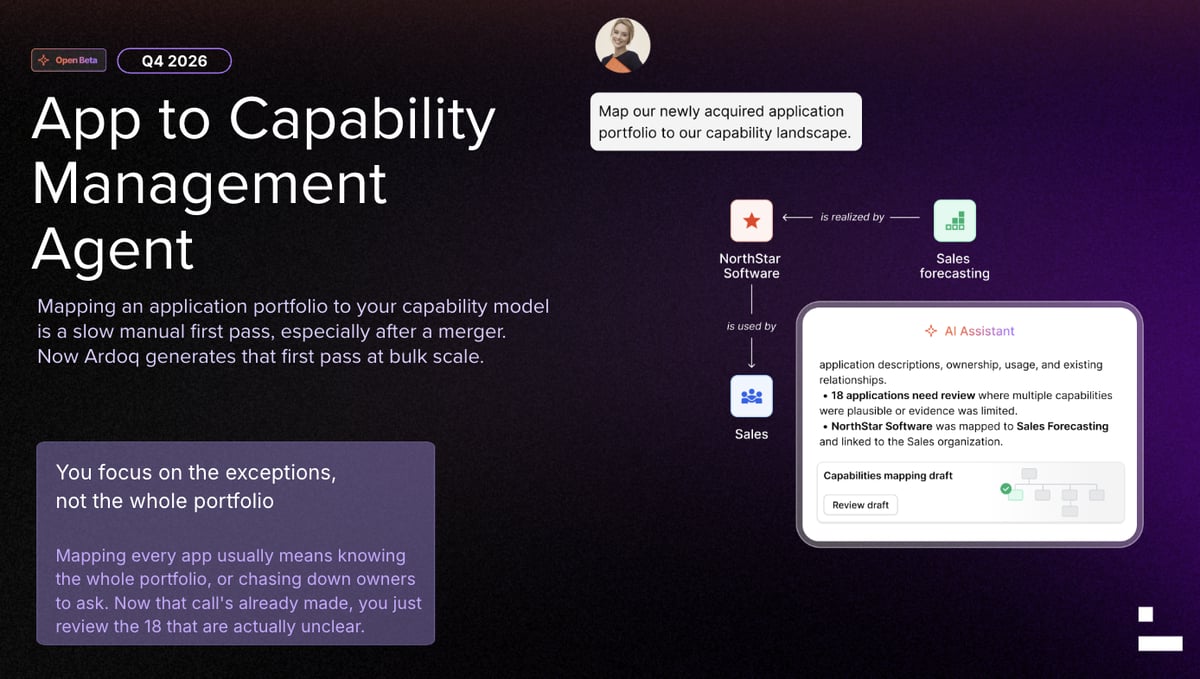
The job it replaces: The slow, manual first pass of mapping an application portfolio to your capability model, especially painful after a merger or acquisition when you're starting from someone else's portfolio.
How it works: Ask the agent to map a portfolio to your capability landscape, and it does the bulk work automatically. In a demo, it mapped a newly acquired portfolio of 212 applications, with just 18 flagged for manual review. Instead of reviewing an entire portfolio, you review the handful of cases that need closer scrutiny. This new agent is an evolution of one of our existing AI features. It's currently in beta this quarter.
Portfolio and Governance: Turn Scattered Records Into Decisions
These two agents take the paperwork and portfolio data nobody has time to fully digest and turn it into structured, usable records.
Application Rationalization Agent (GA)
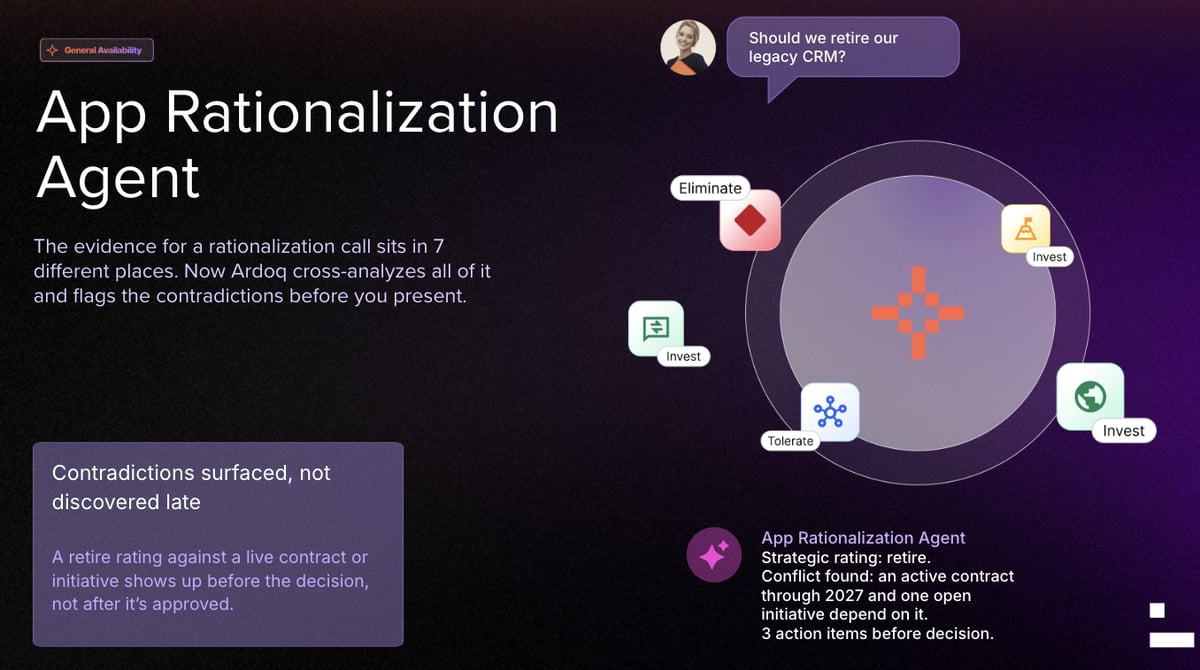
The job it replaces: Manually collating evidence and static analysis for a rationalization call (invest, tolerate, migrate, or retire) from data scattered across seven or more different places.
How it works: Ask whether you should retire a given application, and the agent cross-analyzes your portfolio data and flags contradictions as part of your prep work. In a demo, when asked about retiring a legacy CRM, it returned a "retire" rating, but also flagged two dependencies from an active contract running through 2027, one open initiative, and three action items to resolve before deciding.
Contract & Document Extraction Agent (GA)
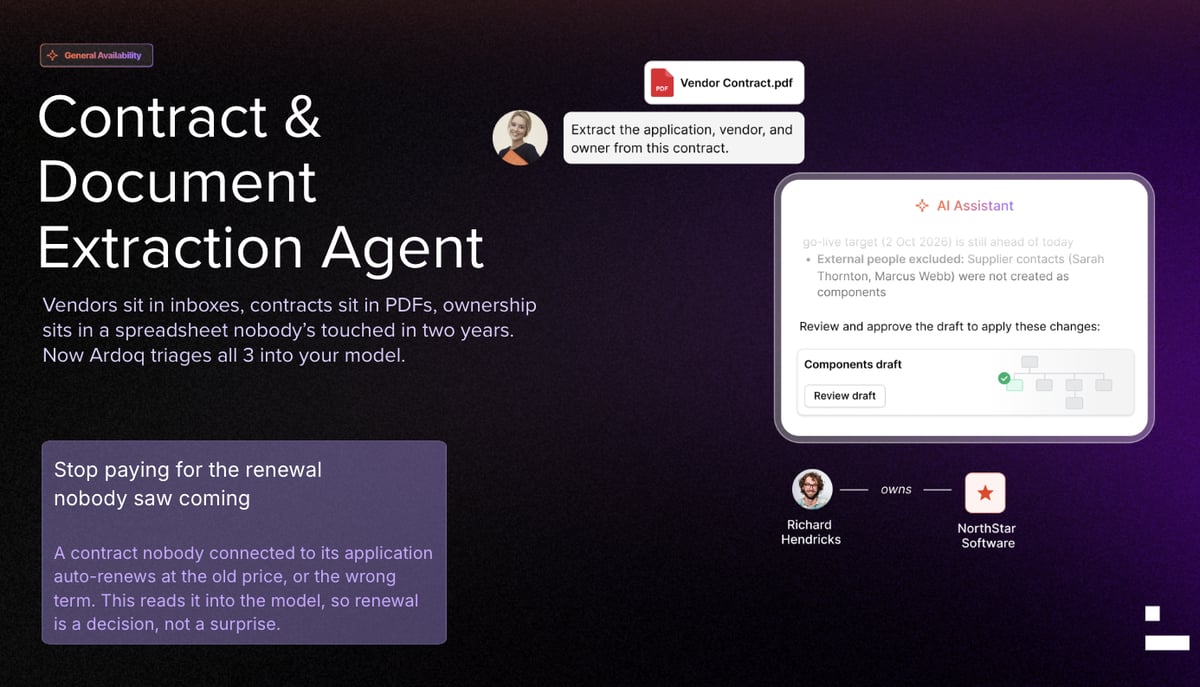
The job it replaces: Manually rereading software contracts to find renewal dates, costs, and obligations, usually under pressure once a renewal deadline is already close.
How it works: Upload a contract and ask the agent to extract the key terms, and it reads the document and turns it into structured data connected to the rest of your architecture. In a demo, it extracted terms from a Workday contract, returning the application, vendor, and owner, and adding them straight to the model for review. That means the numbers behind your software portfolio stay current and connected, instead of trapped in a PDF nobody can find or read until renewal. This is currently rolling out to all customers.
Build Your Own Agent for Your Unique Needs
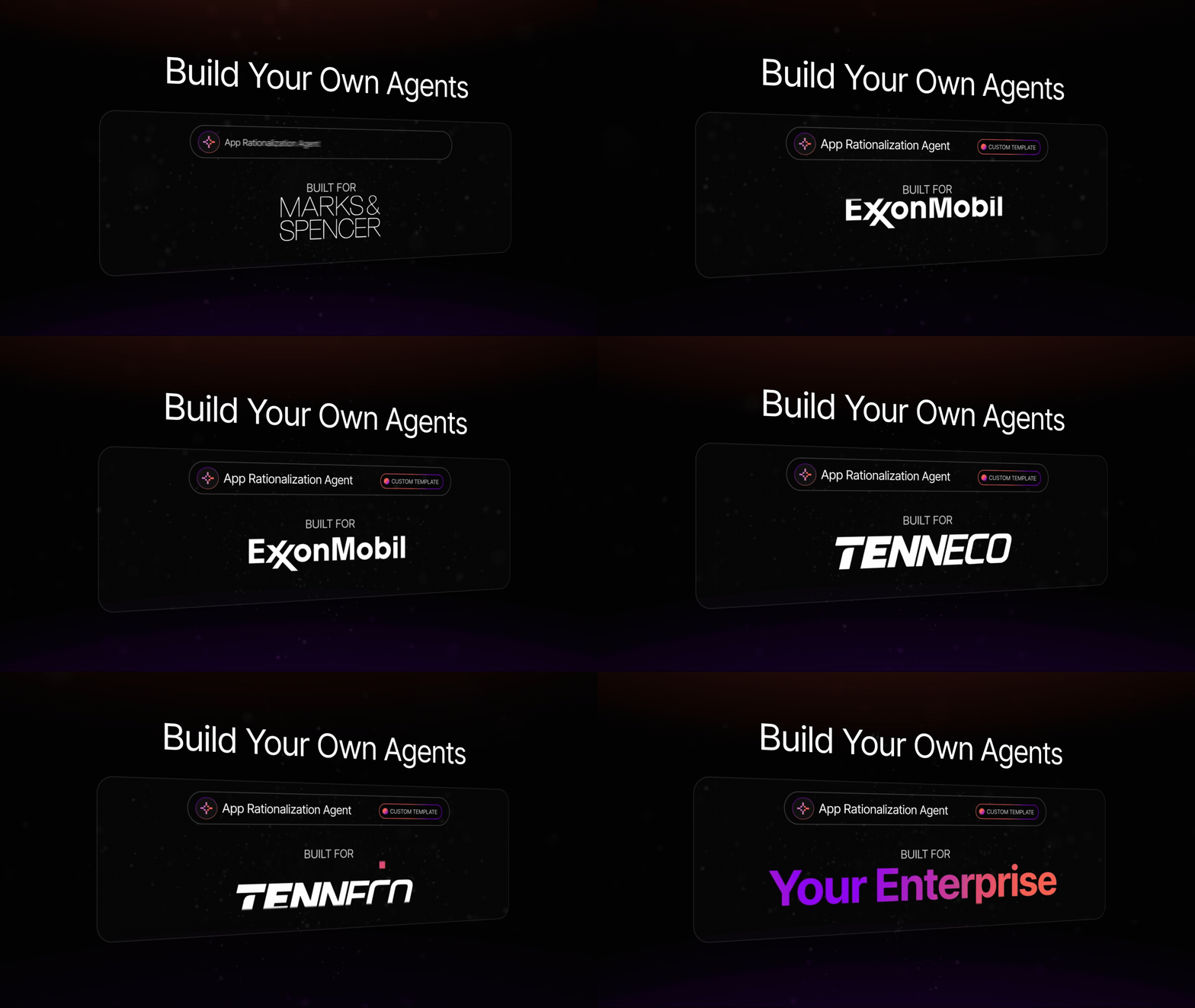
The eight agents above cover the EA jobs almost every team runs into. But your organization has workflows nobody else has, built around your own metamodel, your own approval chains, your own definition of "done." That's what Custom Agents are for.
With Custom Agents, you design your own AI agent instead of waiting for Ardoq to build it for you. You define the instructions it follows, the data and tools it can touch, and exactly what it's allowed to read or write, all inside the same permission model your team already trusts. Nothing runs as a black box. If you can describe the workflow, you can build the agent.
Custom Agents started in beta with an early partner group and will open up to all customers this quarter. If you've got a repetitive, EA-specific task that doesn't match one of the eight prebuilt agents above, this is how you get AI to take some of the load off you.
What This Means for You
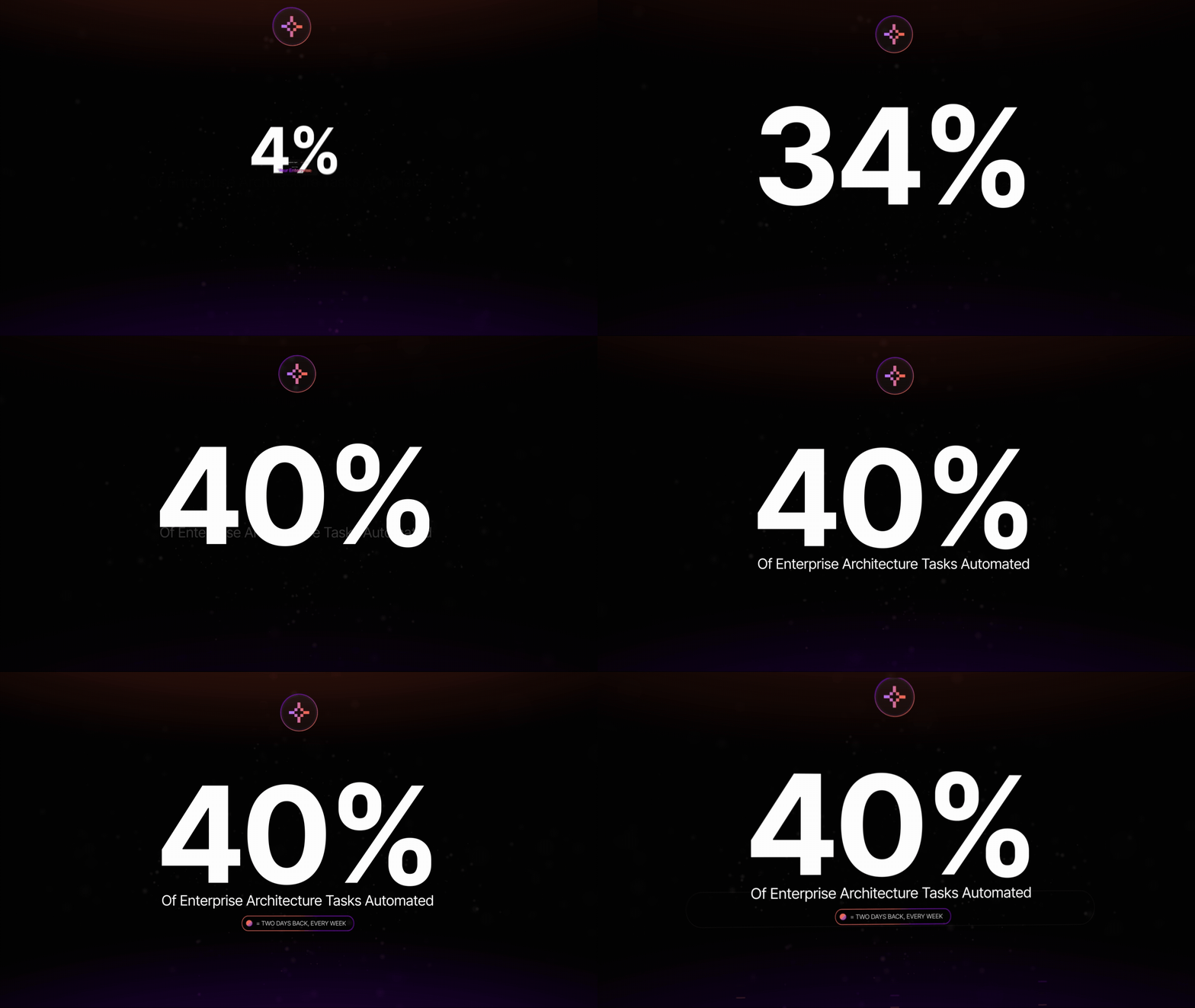
None of these agents replace a human EA's judgment. They replace the hours you spend gathering the evidence before you can use it: a stakeholder map you don't have to build from scratch, a blast radius you don't have to trace by hand, a contract you don't have to reread line by line. That's hours back every week, for the decisions that actually need an architect's discretion.
If you're already an Ardoq customer, ask your CSM which of these agents are live in your instance today. If you're not yet, request a demo, and we'll show you exactly which agent could save your team the most time this quarter.

/Logos/Ardoq/RGB_Ardoq_Logo_Stacked_White_Monochrome%201.png?width=80&height=77&name=RGB_Ardoq_Logo_Stacked_White_Monochrome%201.png)