/Logos/Ardoq/RGB_Ardoq_Logo_Primary_Purple.svg)
A year ago, the question every Enterprise Architecture (EA) leader asked about AI was some version of “What can it do?” Today, the question is, “Can I trust what it just did, and can I prove it to someone else?”
That shift matters more than it sounds. Enterprise AI capability has moved fast: AI agents that chain tasks together, AI assistants that reason across documents and process maps in one conversation, tools that draft first-pass models from existing data. However, AI governance and accuracy verification have not moved at the same speed. Most organizations can now get an AI-generated answer faster than ever, but they cannot confirm that it is correct.
Here’s what stood out from enterprise AI developments in Q3 2026, the themes running underneath those moves, and where Ardoq’s own AI investments fit into that picture.
The AI Got More Capable, But Verifying It Got Harder
Multi-agent orchestration became the next race. Several enterprise software vendors spent Q3 moving from single-purpose AI agents to orchestration layers that chain agents together into multi-step workflows: one agent extracts, another analyzes, a third reports. For EA teams, this means AI is starting to attempt work that used to require a person coordinating multiple tools over multiple days. It also carries serious implications for when the process breaks down. A wrong answer from one agent can now propagate into three more before anyone notices.
Ardoq is entering this space with its own Agent Orchestration capability, moving toward limited availability in Q4 2026. Ardoq’s AI will be able to tackle more complex tasks by breaking requests into a step-by-step plan and executing within defined permissions. This means it will be more flexible, adapting to unforeseen problems, and operating more efficiently overall.
Execution transparency is no longer optional. Across the market, AI assistants and agents increasingly need to show their work: which step they took, which data they queried, which source they used. A year ago this was a differentiator. In Q3, it is a baseline expectation, especially from buyers in highly regulated industries who need to defend a decision, not just receive one.
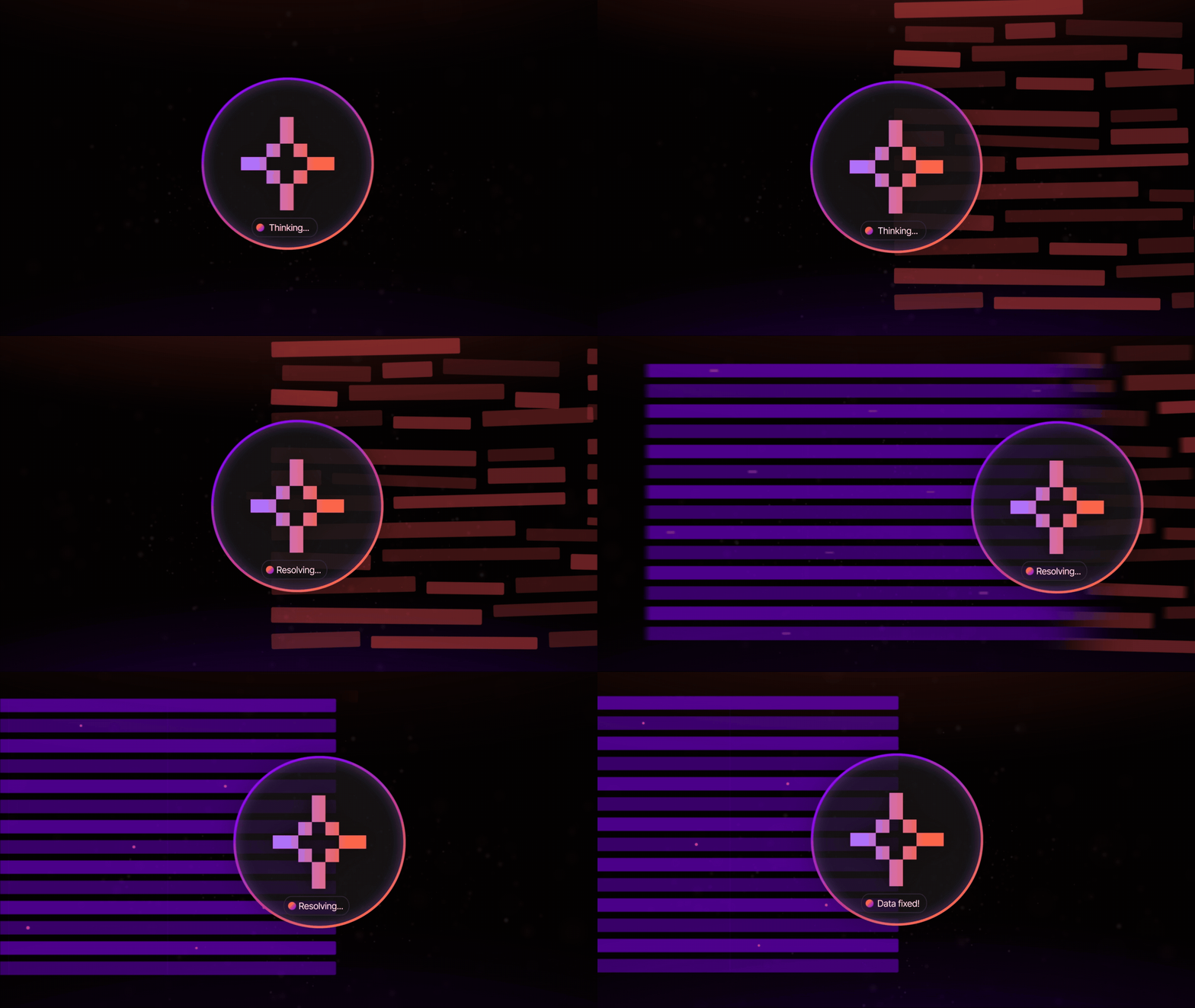
Ardoq shipped two key components for this in Q3. In addition to our Agent Orchestration capability, we launched Live Agent Execution Visualization, so users can watch each step an agent takes in real time, and see the links from every AI answer back to the exact component, field, or source behind it.
Document and contract extraction agents multiplied. Turning unstructured PDFs, contracts, and vendor documents into structured, queryable data is now a common feature across EA and IT asset management tooling, not a novelty. That is good news for architecture teams sitting on years of unread contracts, and a sign that this tedious category of work is finally close to fully automatable.
Ardoq’s own version landed on two fronts this quarter: document processing inside the AI Assistant, so you can attach and reason across documents directly in a conversation, and a dedicated Contract & Document Extraction Agent that reads contracts and turns their terms into structured, queryable architecture data.
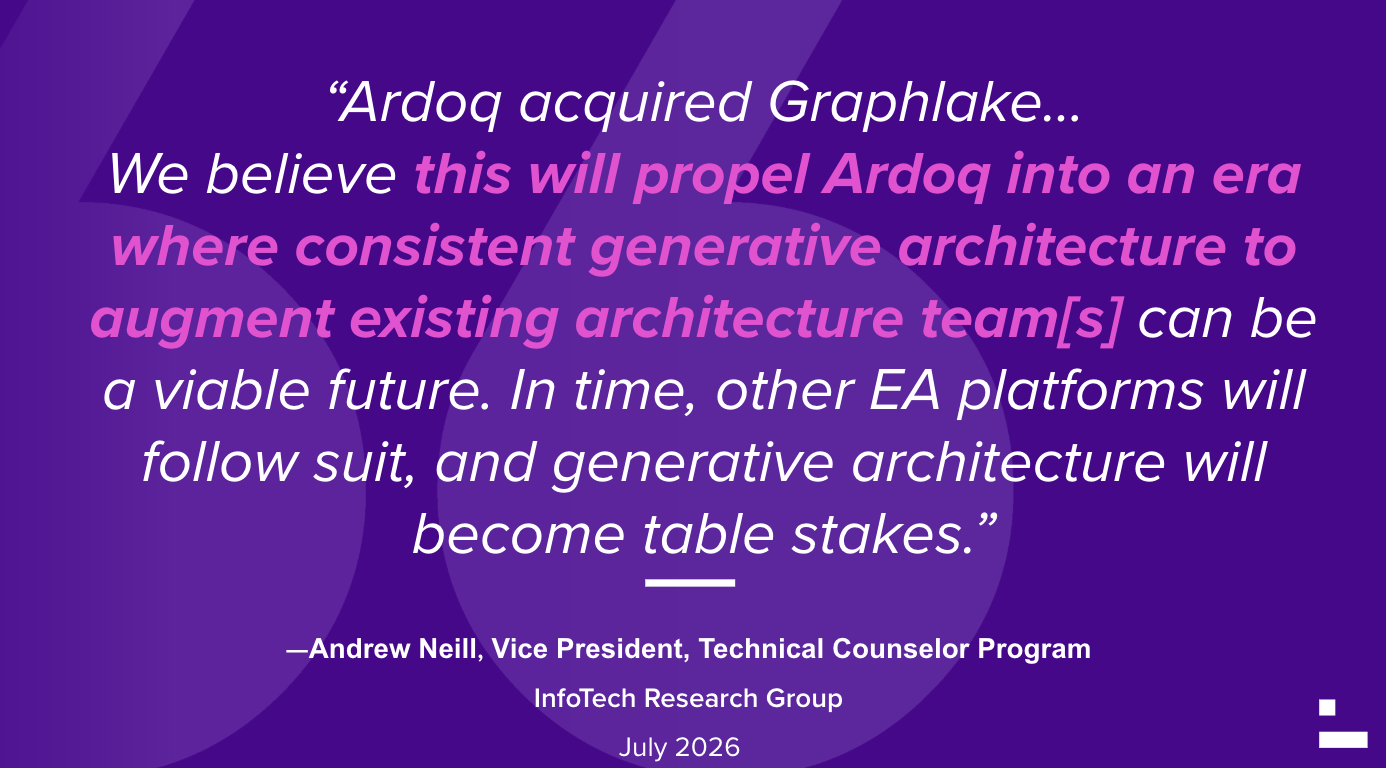
Analysts started naming “generative architecture” as a category, not a curiosity. Info-Tech Research Group used Q3 2026 to make that case directly, pointing to Ardoq’s acquisition of Graphlake as the kind of move that makes generative architecture real rather than a one-off experiment, and predicting that other EA platforms will follow suit until generative architecture becomes table stakes across the market.
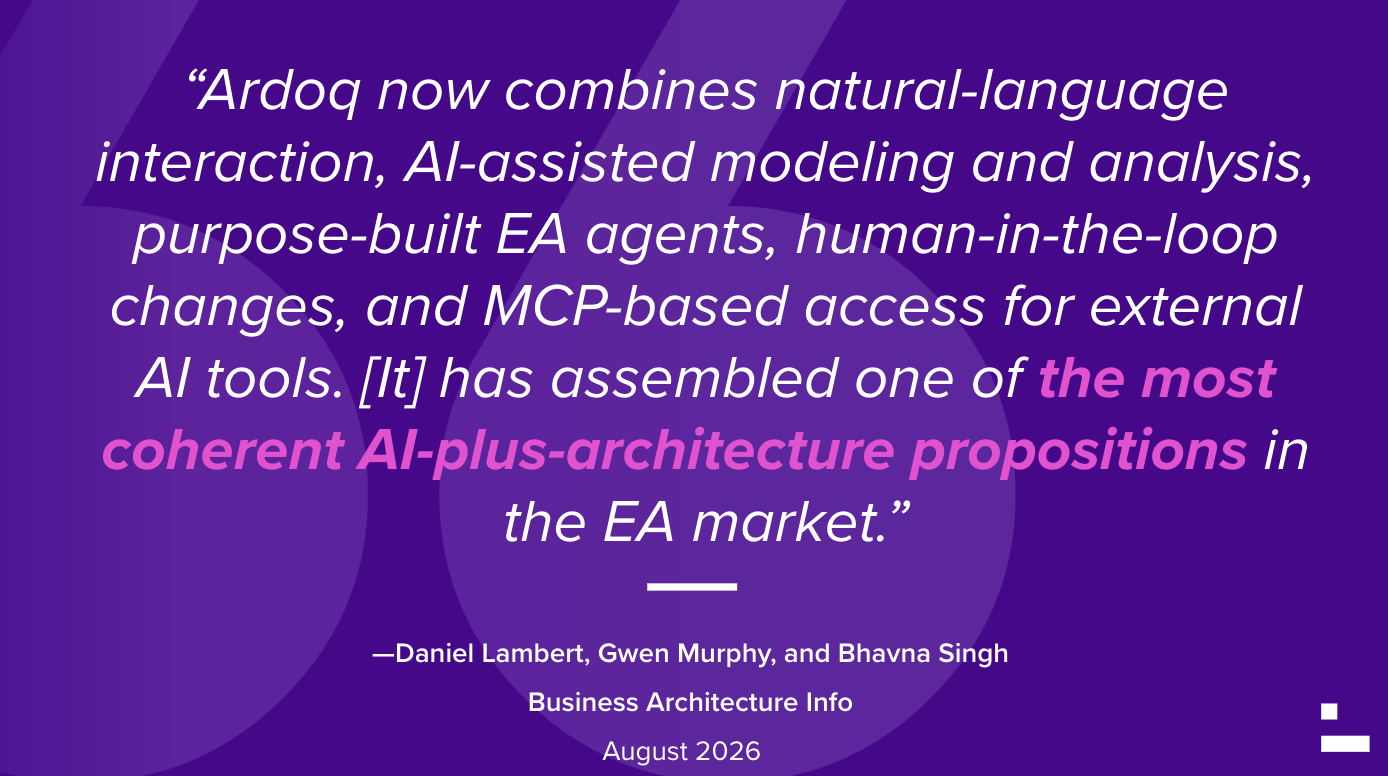
Buyers have started asking vendors to prove accuracy, not just claim it. As agentic AI spread into higher-stakes EA workflows, the conversation shifted from “how capable is your AI” to “how do you know it’s right, and how often is it wrong.” Vendors that can only answer the first question are losing that conversation.
Ardoq’s answer this quarter was AI Quality Benchmarking: publishing the first in a planned series of benchmarks that test its AI output against fixed test sets, with more to follow as the program builds out evidence over time.
Three Things That Separate Real AI Value From Hype
Trust is becoming the differentiator, not capability. Capability is converging quickly across the market. Most serious EA and IT management platforms can now generate a summary, a chart, or a first-draft model. What separates them is whether a user can verify that output before acting on it, and whether the vendor can show, not just assert, how often it’s wrong.
Governance is deliberately catching up to autonomy. The organizations getting real value from agentic AI were not the ones giving AI the most freedom. They were the ones giving it clearly scoped permissions, defined data access, and a human checkpoint before anything changes the model. Autonomy without scope is a massive liability, not a feature.
Data quality is the real bottleneck, not model quality. Every AI output is only as good as the graph, model, or dataset it reasons over. Teams with clean, connected architecture data are the ones seeing AI actually save them time. Teams without it are getting AI-flavored guesses layered on top of the same gaps they had before.
Ardoq’s Bet: Prove the Answer, Don’t Just Give One

Ardoq’s approach to AI in Q3 stayed anchored to one idea: automation with a purpose, not automation for its own sake. The goal is to remove the manual grind that keeps architects from spending time on judgment calls, not to replace the judgment itself.
That showed up in a few concrete ways this quarter. Ardoq’s dramatically enhanced AI Assistant now generates one query that runs directly against the architecture graph rather than assembling an answer from several separate calls. Every answer links back to the exact component, field, or source behind it, so you can check a claim in one click instead of taking it on faith. Custom Agents moved into open beta for all customers, letting organizations define their own agents with their own instructions, tools, and permissions on their existing architecture graph, rather than adopting a generic AI layer with no visibility into how it reasons.
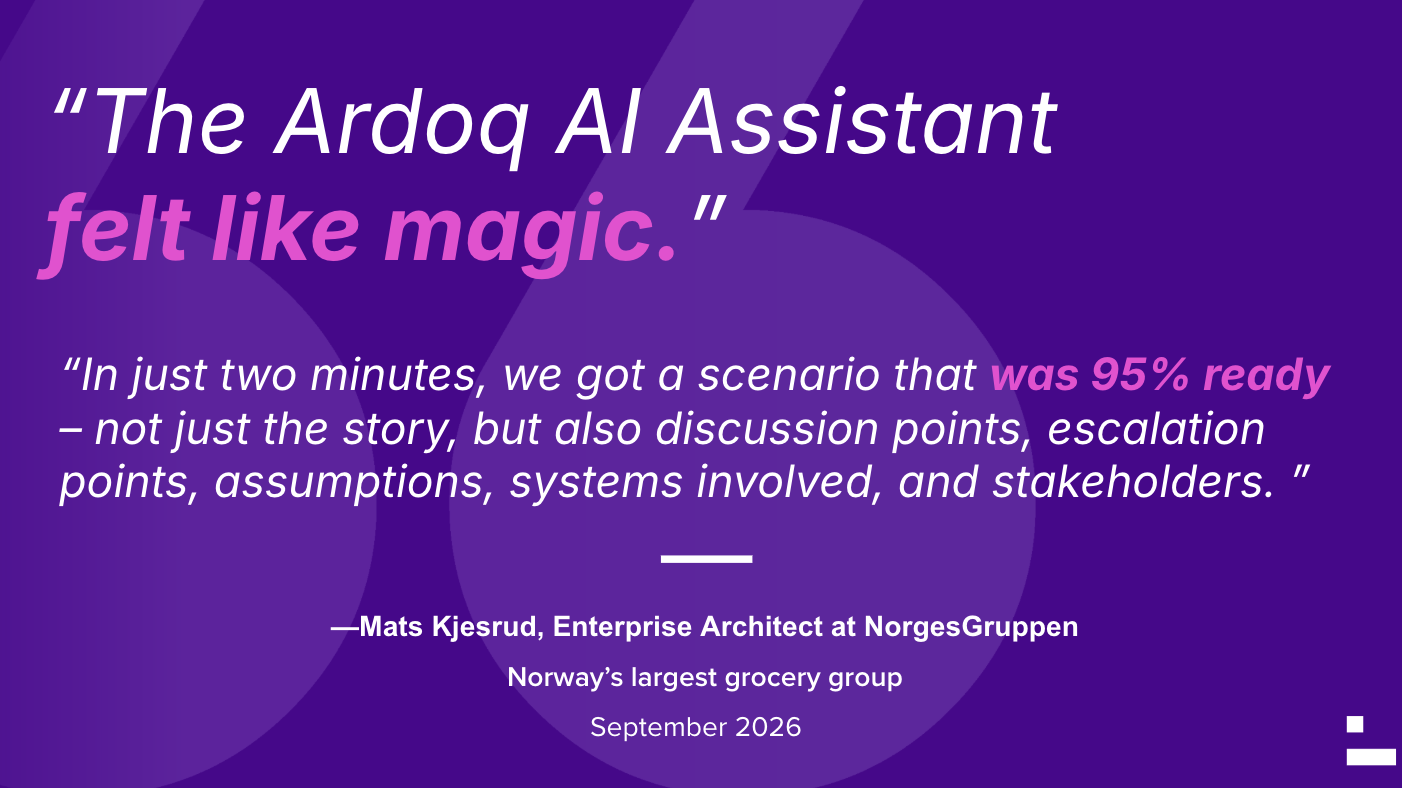
Ardoq is also committing to publish its own AI accuracy numbers against a defined target, reporting progress as that program comes online. That is a direct response to the theme above, where most AI vendors are asking buyers to take accuracy on faith. We believe that showing the number, even an imperfect one, is more useful to an EA leader than a confident unsubstantiated claim.
Ask This Before You Trust Your Next AI Answer
Going into Q4, AI features are table stakes. What separates EA leaders is one question they can actually answer: when your AI tool is wrong, how do you know, and how often does it happen?
Learn more about all of Ardoq’s AI capabilities and how we’re building traceable outputs you can trust: AI and Innovation at Ardoq

/Logos/Ardoq/RGB_Ardoq_Logo_Stacked_White_Monochrome%201.png?width=80&height=77&name=RGB_Ardoq_Logo_Stacked_White_Monochrome%201.png)