/Logos/Ardoq/RGB_Ardoq_Logo_Primary_Purple.svg)
Have you ever asked two different AIs, say Gemini and Claude, the exact same question about the exact same spreadsheet, and gotten two different answers? There should only be one right answer, so why aren't they the same, and are they even correct?
The problem is that even with the same data and question, generic LLMs rely on pattern matching to generate a confident-sounding answer as quickly as possible. Accuracy and correctness are not factored in, and neither is robust verification. There's no transparency into the LLM's "reasoning," so you can't be sure a generic LLM's answer that could inform a million-dollar divestiture or a regulatory compliance call is correct.
This is the illusion of accuracy: a response that reads as certain, is backed by real data, and is still incorrect in a way that only becomes evident after it's been acted on. Generic AI agents connected to your enterprise data run into this problem by design, because they aren't able to catch reasoning as it starts to drift.
A generic agent can access your data, but only Ardoq's AI is engineered to reason over it reliably enough to act on it.
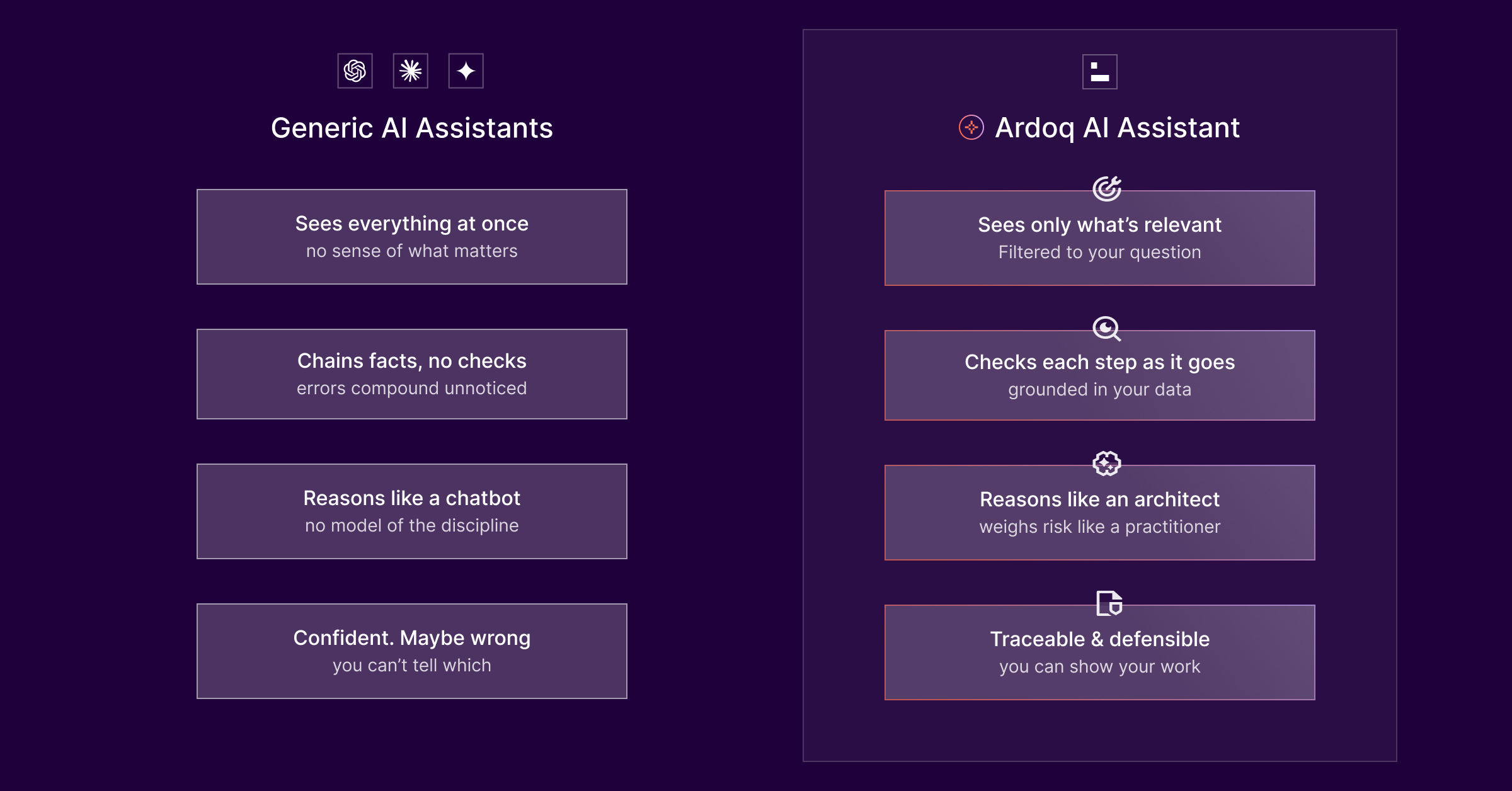
The Four Blind Spots of Generic LLMs for EA: Why Confident Isn't the Same as Correct
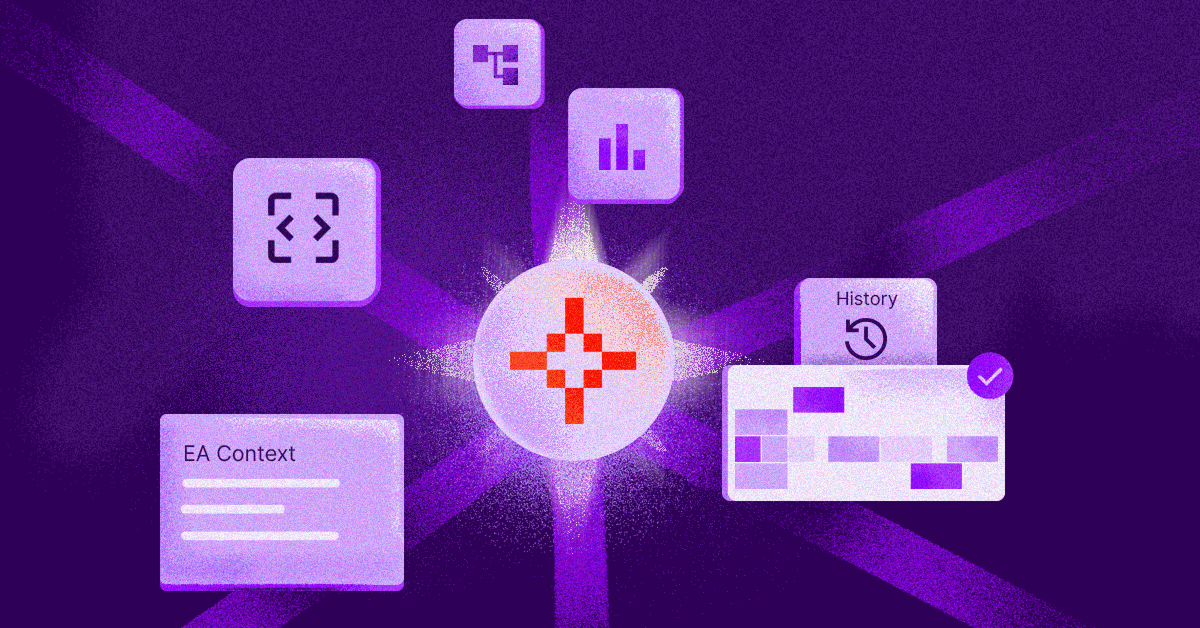
Generic AI agents can reach your enterprise data today through tools like MCP. However, accessing data and reasoning over it reliably enough to act on are two different things, and connecting a generic agent to more of your architecture doesn't address the fundamental issue: there is no way to control or trace how generic LLMs reason. This lack of control results in four significant blind spots.
- Generic LLMs see everything at once. Every file you share with the LLM lands in view together, so it has no understanding of what should be prioritized or the hierarchy of data importance.
- Generic LLMs chain facts. Every step runs based on the last one, so each additional fact the model has to chain together is another opportunity to get something slightly wrong. Those small errors compound rather than cancel out. Answer accuracy also drops rapidly the longer chains get, falling as low as 43% once more than 10 facts are involved, and most valuable questions about your architecture depend on multiple facts.
- Generic LLMs lack an understanding of your enterprise's actual architecture. Access to data doesn't mean understanding the full architectural context or its implications for your organization.
- Generic LLMs don't show their reasoning, making answers untraceable. Even when you've spotted an incorrect answer, there's no trail back to where the reasoning broke.
According to model reliability benchmark studies at Princeton, the correctness of generic LLMs falls fast when a question depends on more connected facts: 77% at three dependent facts, 65% at five, and down to 43% at ten, worse odds than a coin flip.
A confident answer built with all the blind spots above is not a minor risk. If a decision-maker acts on an answer without knowing the odds, the AI hasn't actually helped them. It has just moved the risk somewhere less visible, and somewhere much harder to catch after the fact.
Picture a divestiture. An architect asks which applications, integrations, and data flows need to move with the divested business unit. That single question depends on a chain of connected facts about ownership, shared infrastructure, downstream dependencies, and contractual obligations. Ten facts deep is not a stretch for a question like this. A generic agent answering with a 43% chance of being right, dressed up as a clean, confident paragraph, is not a shortcut to better, reliable decisions.
This is why Ardoq built its own native AI Assistant instead of stopping at data access. Same data, but engineered for what happens after the data lands in front of the model: what it's shown, how it reasons through the problem, and whether its logic would hold up to an architect's scrutiny.
This matters more now than it did a year ago. Enterprises are burning through AI budgets and starting to question the return, so reliability, not novelty, is needed to justify growing spend. A model with rapid but incorrect answers doesn't save anyone time or money. It just shifts the work to whoever has to catch the mistake, increasing the risk.
Generic LLMs vs. Ardoq's AI: A Breakdown of Capabilities and Trustworthiness
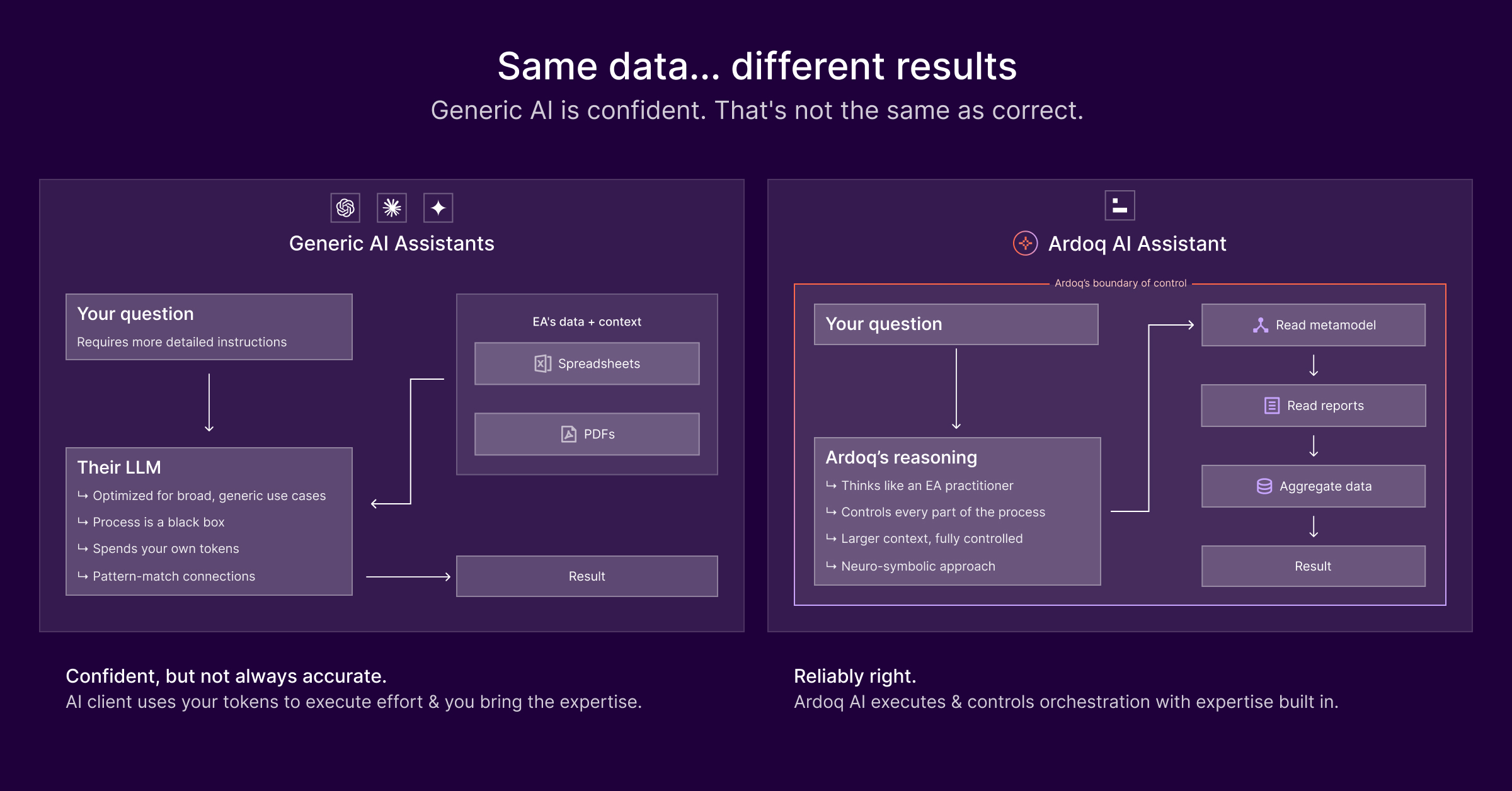
The difference between generic LLMs and Ardoq's AI is vast. Think of a generic AI assistant as a brand-new hire on day one. They're handed every file in the building at once, with no context on which information is most trustworthy and up to date, which systems are legacy, or what matters most to your business. They'll still come up with a confident-sounding answer, because they're reluctant to say "I don't know" despite lacking the judgment to tell signal from noise.
Ardoq's AI Assistant is like the architect who's been on the team for years. They already know your metamodel, your systems, which reports are gospel and which are three reorgs out of date, and what actually matters to the business. So when you ask it a question, it doesn't need the whole filing cabinet; it already knows which files are most relevant, and it can check its findings against what it knows before handing you an answer.
| Generic LLM alone (ChatGPT, Claude, Gemini with no data connection) |
Generic LLM using MCP (connected to enterprise data via MCP servers) |
Ardoq's AI Assistant | |
|---|---|---|---|
| Access to your architecture data | ❌ No native support | ✅ Yes | ✅ Yes |
| Deciding what the LLM sees | ❌ N/A | ⚠️ The model guesses based on live data | ✅ Ardoq filters to fit the question |
| Context window behavior | ❌ Nothing connected | ❌ Floods fast; tool data alone can eat 25 to 30% of it, hurting accuracy and cost | ✅ Stays controlled, no matter how many sources connect |
| Reasoning over multi-step chains | ❌ No chain, but can still sound confident | ⚠️ Each step runs fresh, unchecked; agents often add tools rather than improve reasoning | ✅ Grounds every step, so long chains don't quietly drift |
| Domain expertise (EA-specific reasoning) | ❌ Can discuss EA in general, not your practice or specific context | ❌ Can discuss EA in general, not your practice or specific context | ✅ EA judgment is built in, so it reasons like a practitioner |
| Accuracy at scale | ❌ No real facts to reason over | ⚠️ Drops fast; ten chained facts can mean only 43% accuracy | ✅ Same math, but each step gets checked, so errors don't stack |
| Traceability / auditability | ❌ None | ❌ Weak; failures can drop data silently | ✅ Built in. Every fact traces to its source; GraphLake will further strengthen this |
| Reliability at enterprise scale | ❌ Not built for this | ⚠️ OK for prototypes; more connections mean more hidden failure points | ✅ Secure and built for production. Five-time Gartner MQ Leader in EA |
The Three Things That Actually Control Accuracy
The overarching difference between a generic agent and Ardoq's AI Assistant comes down to control and transparency. To overcome the weaknesses of a purely inference-based LLM, Ardoq made three key design choices, each one solving a specific way generic AI breaks down at enterprise scale. Together, these choices give higher control over what data an AI consumes, when it consumes it, and how it handles what it receives.
Controlled Context
A generic agent connected through MCP is often handed every available tool and every retrievable scrap of data at once, the equivalent of being handed an entire filing cabinet when you asked for one folder. The model has to guess what actually matters to your question, and that guesswork is where relevant details get buried under irrelevant ones.
Ardoq's AI Assistant crafts its own system prompt, using progressive discovery and tool filtering to hand the model only what is relevant to your estate. This means the assistant isn't drowning in noise before it has even started reasoning, so it prioritizes what matters to your query instead of everything that happens to be available.
Controlled Orchestration
Long reasoning chains are where accuracy drops off fastest, and a generic agent has no built-in way to check its own steps as it goes. It keeps chaining facts together, compounding small errors until the final answer sounds confident and is quietly wrong.
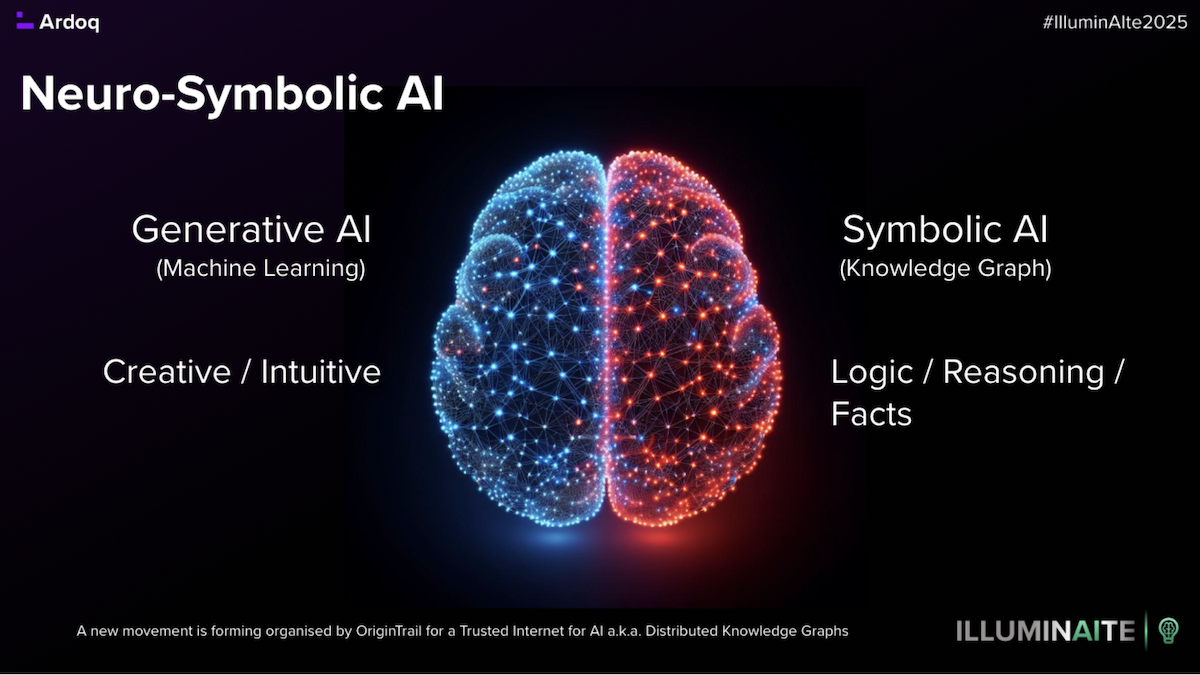
To address this, Ardoq takes a neuro-symbolic approach to AI: pairing two systems instead of relying on one, so a large language model handles language and pattern recognition while a rules-based, "symbolic" layer checks those outputs against structured logic and verified data. Deterministic execution grounds every step of the reasoning chain, checking answers against ontology and graph guardrails as it goes. A long chain of reasoning doesn't silently drift off course; each step is verifiable, not just plausible enough to pass.
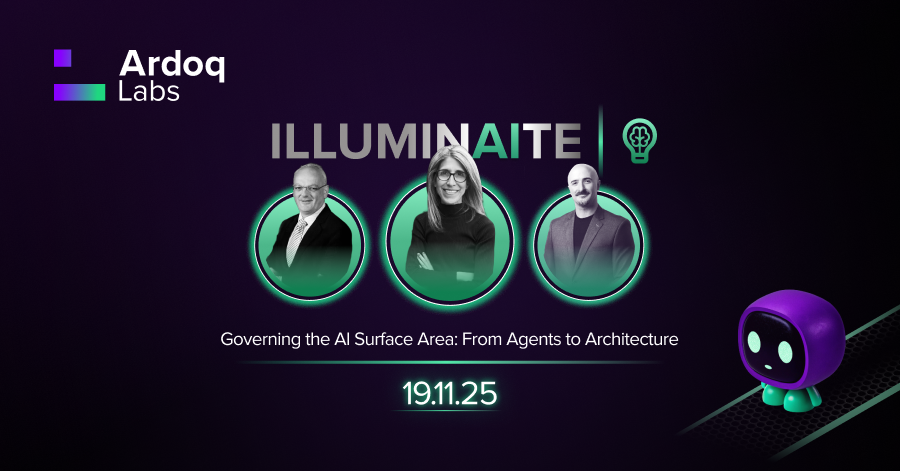
Curious what this looks like in practice? Watch our webinar on Governing the AI Surface Area: From Agents to Architecture.
Domain Reasoning, Not Just Data Access
A generic LLM can retrieve information about your applications, capabilities, and risks. It doesn't know what any of that means in an enterprise architecture context, because it has no model of the discipline itself. It can find the data, but it doesn't reason like the people who built it.
Ardoq encodes EA expertise as rubrics and heuristics on top of a structured ontology and graph. This means Ardoq's AI Assistant reasons the way an architect would, weighing dependencies and risk the way a practitioner does, not the way a chatbot that happens to have access to your data would.
What This Looks Like in Practice
This is not theoretical.
At NorgesGruppen, Norway's largest grocery group, an architect generated a full disaster-recovery scenario from their own data in just two minutes. This exercise would typically involve consultants and take far more time. Their reaction: “It felt like magic.” That is what it looks like when reasoning holds up instead of just sounding right.
“We have used the Ardoq AI Assistant to design contingency exercises. In just two minutes, we got a scenario that was 95% ready – not just the story, but also discussion points, escalation points, assumptions, systems involved, and stakeholders. The Ardoq AI Assistant felt like magic. In a large and complex organization, being able to chat with the data makes things a lot easier, especially when you don’t know all the details of the data model.
- Mats Kjesrud, Enterprise Architect at NorgesGruppen
At Tenneco, AI automation built on this approach delivered a 292% ROI and reclaimed the equivalent of 1.25 full-time employees. That's a productivity stat even non-technical stakeholders like your CFO can appreciate.
Adoption tells a similar story. Weekly active users of Ardoq's AI grew approximately 16x after the Ardoq AI Assistant launched. People don't keep coming back to a tool they don't trust, and the growth curve suggests trust is exactly what changed.
At Belgian professional services providor Liantis, Ardoq's AI Assistant has significantly helped people self-serve routine lookups and information, freeing up valuable time for the core architecture team.
“People reach out to it in the Ardoq interface out of habit, to ask things like who is the architect for this. The AI assistant was powerful at bringing up the right people.”
- Stijn Lambert, Lead Solution Architect at Liantis
If you want to see the research and detailed thinking behind all of this, Ardoq's approach to reliable AI for Enterprise Architecture lays out what we've built and why. Or if you'd rather put the assistant to work on your own architecture, book a demo and ask it something hard.
Traceable, Auditable, Defensible
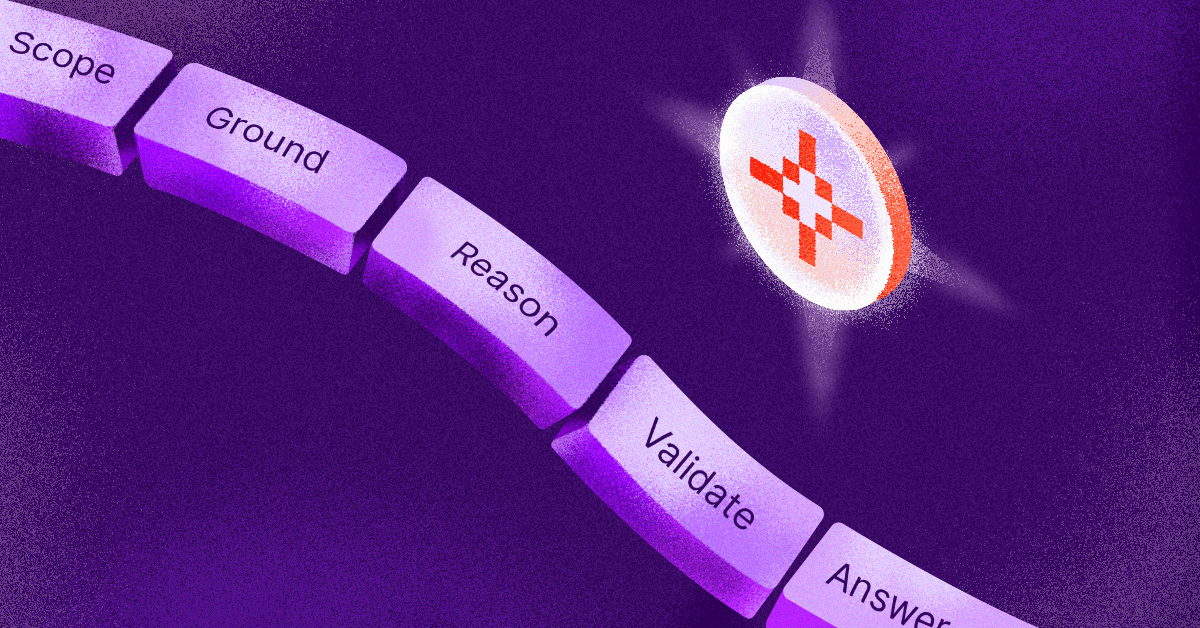
None of this makes MCP or generic AI agents obsolete. Ardoq still supports them, because reaching enterprise data through more channels is broadly beneficial for the ecosystem. What changes is what a CIO or CTO can actually defend when someone asks how an AI-backed decision got made.
An answer that is traceable, auditable, and defensible means you can show your work: what data the assistant saw, how it moved from question to answer, and why that reasoning holds up under the same scrutiny an experienced architect would apply. That should be the bar for anything a decision-maker acts on, and it's a bar that generic agents aren't built to clear on their own. This is the thinking behind Ardoq's acquisition of GraphLake, which gives every fact in the enterprise graph a decision trace: where it came from, who asserted it, and when. That makes traceable and auditable a property of the data itself, not a feature bolted onto an AI agent after the fact.
Ardoq's five consecutive years as a Gartner Magic Quadrant Leader, and its track record of shipping frontier AI capability first, including MCP in general availability and Custom Agents, is not incidental to this story of intentionally building toward a trustworthy and accessible single source of truth for the whole organization. Ardoq's acquisition of GraphLake will further expand its capabilities as it evolves into the leading context graph, providing even more transparency and traceability for data-driven decisions.
AI is only going to move closer to the center of architecture decisions, not further from it. As that happens, the question stops being whether an AI can answer, and starts being whether you can trust the answer enough to act on it. That is a harder bar to clear, and it is the only one that actually matters.
Same data but vastly different answers to drive real results, value for our customers, and actual productivity gains without sacrificing reliability or transparency. That is the difference that is worth building for.
- Blog Posts Ardoq Becomes First EA Platform to Support AI-Level Reasoning via MCP Ardoq's New Agentic AI Workforce: Your Virtual Architects On Demand For Spring 2026
- Customer Stories How Tenneco’s EA Team Is Planning to Use Ardoq’s AI to Reclaim 40% of Their Time
- Help Articles Ardoq's approach to reliable AI for Enterprise Architecture

/Logos/Ardoq/RGB_Ardoq_Logo_Stacked_White_Monochrome%201.png?width=80&height=77&name=RGB_Ardoq_Logo_Stacked_White_Monochrome%201.png)