/Logos/Ardoq/RGB_Ardoq_Logo_Primary_Purple.svg)
How Tenneco’s EA Team Is Planning to Use Ardoq’s AI to Reclaim 40% of Their Time
- Reducing operational drag and scaling impact with AI
- Potentially reclaiming 40% of EA team's capacity
- Estimated 1.25 FTE worth of time can be saved with automation
/Photos/Customers/tenneco.jpeg?width=1094&height=680&name=tenneco.jpeg)
/Logos/Customers/tenneco%20logo.png?width=2000&height=323&name=tenneco%20logo.png)
At Tenneco, Enterprise Architect leading Technology Governance & Agentic Automation practice, Abby Cletus and his team found themselves in a position familiar to many EA teams. While their architecture data was solid and their models were up to date,the team had limited capacity to serve growing business demands. The business was not fully able to self-serve EA insights so too much of the EA team’s time was being consumed by small, repetitive requests. They were important questions, but not ones that required an architect’s judgment every single time.
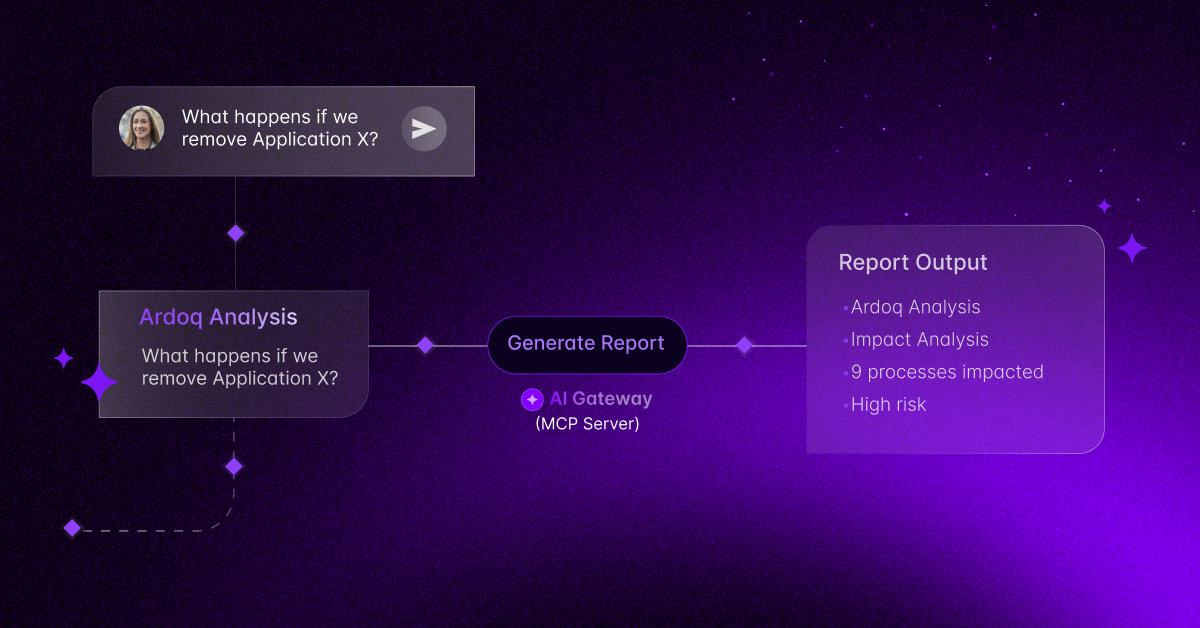
Rather than hiring more people or producing yet another layer of reports, Abby decided to change the way architecture knowledge flows through his organization using Ardoq’s AI Gateway (MCP Server) as a practical way to operationalize that shift.
Before MCP
Architecture by Constant Interruption
Before introducing Ardoq’s AI Gateway (MCP Server), architecture knowledge at Tenneco moved the way it does in many enterprises today: through people.
On average, the team handled around six application-related questions per week, every week, a steady operational tax on EA capacity. Questions such as:
-
What is the best application for this business case?
-
Which contracts are expiring with limited users and high tech debt?
These were not hard questions because all of the answers already existed in Ardoq. But for many business stakeholders, especially those who needed answers urgently, navigating a new software platform was simply too high a barrier, even if the data visualizations, custom presentations, viewpoints, and search bars were easily accessible in Ardoq.
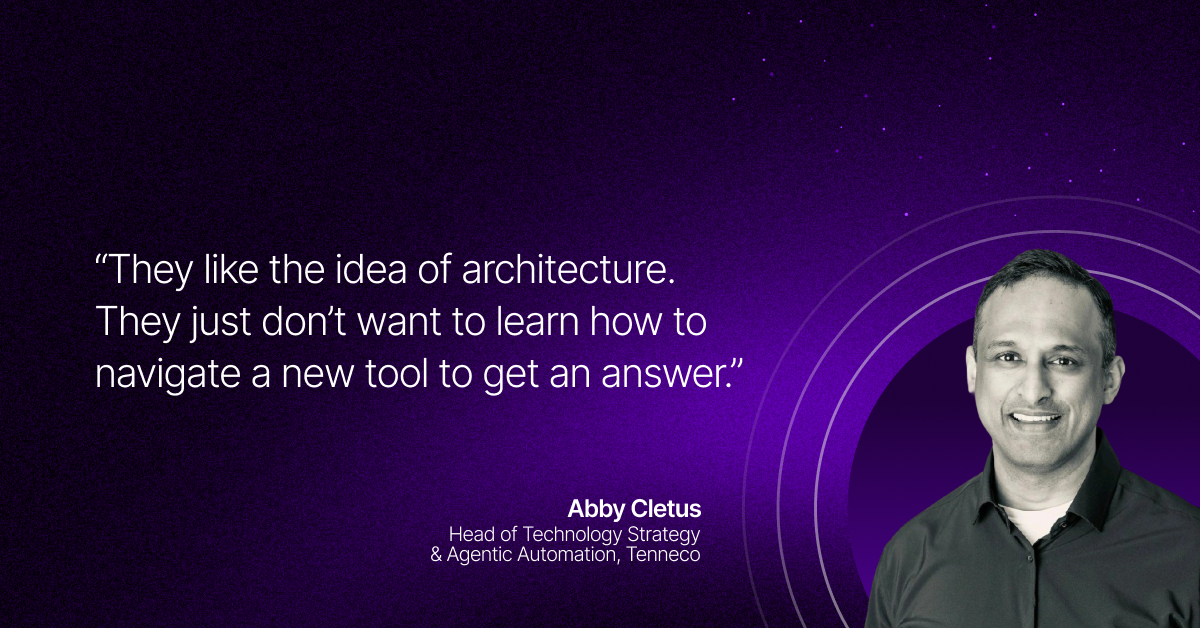
“They like the idea of architecture. They just don’t want to learn how to navigate a new tool to get an answer.”
- Abby Cletus, Lead for Technology Governance & Agentic Automation
So they did what made sense: they asked the EA team to retrieve the information for them.
The Hidden Cost of “Just a Quick Question”
Each question triggered a familiar pattern:
- An EA (often a junior architect) would pull a report
- Filter and cross-check the data
- Assemble a response
- Send back screenshots, links, or slides
Individually, these requests felt manageable. Collectively, they added up to a significant drain on the team’s capacity.
“That’s the kind of work we want to get out of,” Abby says. “We don’t want to be spending our time answering operational questions. We want to be operating in a more strategic space.”
This is where Ardoq’s AI Gateway (MCP Server) entered the picture.
How Ardoq MCP Helped: "It's like an extra EA on my team"
When Abby describes Ardoq’s MCP, he doesn’t talk about it as a chatbot. He talks about it as an extra teammate. In practice, MCP becomes a standing member of the EA team, absorbing interruptions so architects don’t have to context-switch away from higher-value work.
“I’ve got three humans, and now I’ve got an agent responding to all those application-related queries.”
- Abby Cletus
Today at Tenneco, MCP is used primarily by the EA team itself: eight architects, still early in the journey of fine-tuning it for broader stakeholder adoption. Within that scope, the team has already:
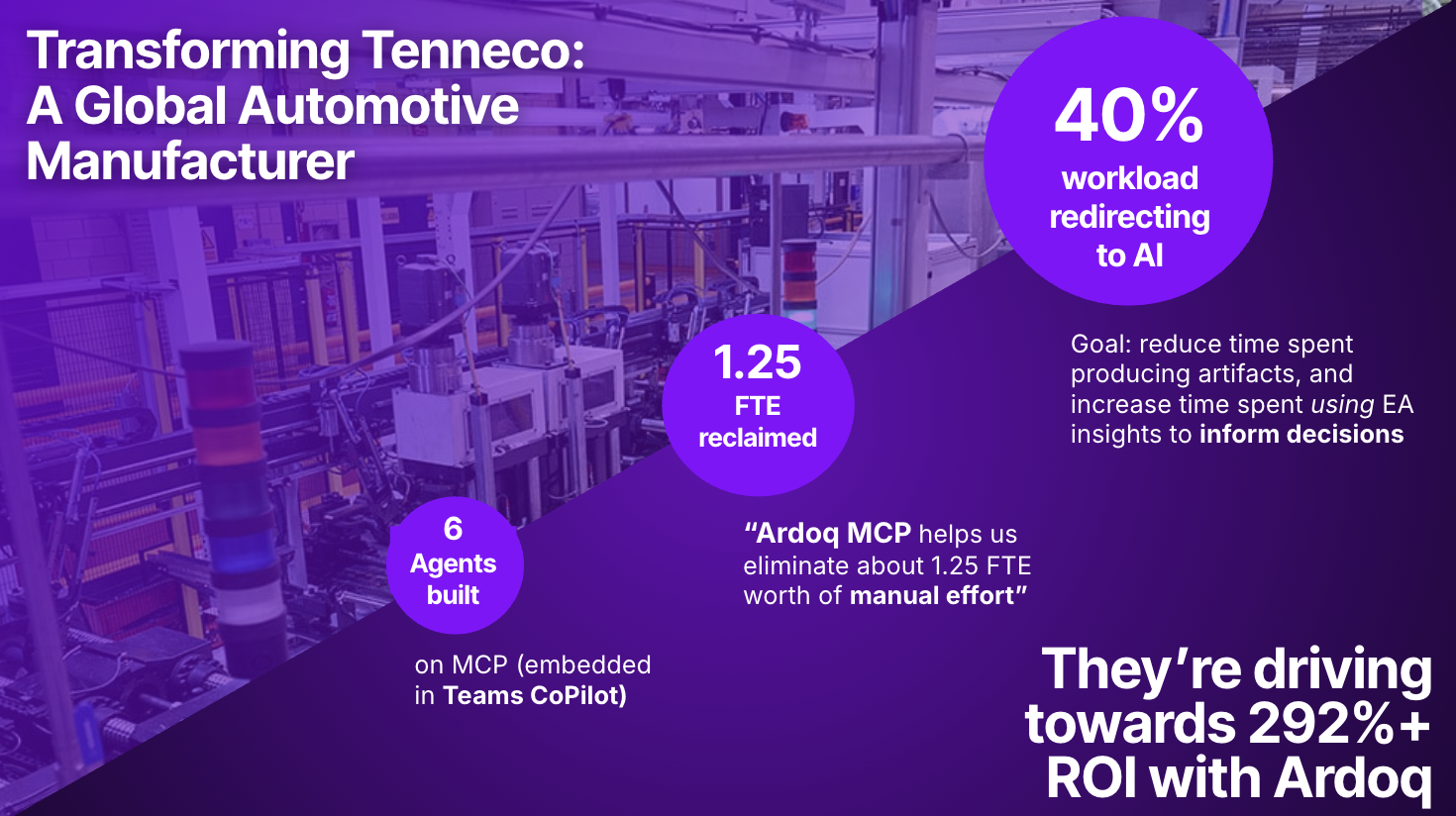
- Begun building 6 MCP-based agents focused on various EA use cases
- Embedded them in Microsoft Teams CoPilot
- Started defining topics and top use cases for further agent build-outs
Even at this early stage, Abby estimates that this can already help them eliminate about 1.25 FTE worth of manual effort, specifically tied to the Ardoq MCP-driven automations.
That reclaimed time doesn’t disappear. It gets redirected.
Key Outcomes With Ardoq: Why Conversational Access Changes Everything
Ardoq MCP is Tenneco’s EA Force Multiplier
Based on current usage and early results, Abby estimates that MCP alone could reclaim approximately 1.25 FTE worth of effort, by automating routine queries, enabling true self-service, and helping answer questions that could not have been answered before.
This number is a projection, but it’s grounded in lived experience: fewer interruptions, fewer manual report pulls, and fewer “quick questions” that quietly consume architect time.
What excites Abby most isn’t the metric itself, it’s the implication.
Rather than asking for more headcount or a bigger budget, MCP allows the EA team to scale their impact by encoding their knowledge into AI Agents. The team’s expertise becomes available on demand, without being constrained by availability or bandwidth.
“It feels like we’re multiplying the team,” Abby says, “without multiplying headcount.”
Reducing Barriers to Engagement Outside the EA Team
One of the most important shifts MCP introduced wasn’t speed, it was comfort.
When architecture knowledge is locked behind reports and EA tools, fewer people feel confident engaging with it. When it’s accessible through natural language, it changes people's willingness to participate.
“The ‘ask a question, get an answer’ model removes a lot of friction,” Abby notes. “It opens up architecture to people who might otherwise hesitate to ask a question, especially when people can ask questions privately, without worrying whether it’s something they ‘should already know’ or if they are interrupting someone else’s work.”
This is a subtle but powerful shift. Enterprise Architecture stops being something you navigate and starts being something you engage with.
More Than Efficiency: Space For Work Satisfaction
When you combine Ardoq AI overall with MCP-driven automation, the outcome isn’t just speed or cost savings.
It’s space.
- Space to focus on strategy to execution
- Space to get your hands dirty with deep analysis of cost, risk, and technical debt
- Space for EAs to engage earlier and more strategically
- Space for a happier EA team overall
This is what AI-powered Enterprise Architecture looks like, not replacing architects, but amplifying them. And for Abby and his team, this is still just the beginning.
Next Steps
Evolving the Use of MCP: AI Reasoning Agents, Not Just Recall
What makes Tenneco’s story especially forward-looking is how Abby thinks about MCP Agents.
These Ardoq MCP Agents aren’t just read-only bots. They are becoming reasoning layers, capable of stitching together context across applications, ownership, tickets, and initiatives. This is how architecture knowledge begins to scale without linear growth in the EA team.
“It’s not about answering more questions. It’s about supporting hard questions with strong insights and recommendations, without the manual work in the background.”
- Abby Cletus
Abby and his team are intentionally evolving MCP usage through phases:
Phase 1 – Operational
Simple, high-frequency questions: How many supply chain initiatives do we have?
Phase 2 – Tactical
Richer context: Getting a list application with a business process score of "Yellow – Multiple Apps per Process (Rationalization Opportunity)" that needs to be evaluated for operational improvements.
Phase 3 – Strategic
Decision support: Which approved vendors have active agreements to provide physical security ?
Scaling Beyond EA: 85 Business Stakeholders
Today Ardoq MCP Agents are being used internally by the Tenneco EA team. Next, Abby plans to roll them out through Microsoft Teams and Copilot to around 85 business stakeholders.
Even conservatively, they estimate that 85 users with just one question per month will result in 1,020 architecture questions per year.
That’s over a thousand interactions that no longer interrupt an architect’s day.
Instead of acting as a human interface to architecture data, the EA team becomes a force multiplier, supported by Ardoq MCP Agents that carry their knowledge into the business.
More Than Just MCP: Redirecting 40% of EA’s Workload to AI
Abby is very deliberate in how he talks about AI’s impact on his team. This isn’t a single metric tied to a single feature, it’s the cumulative effect of automation across the EA workflow.
“Do we have all those strategic answers right now? No,” he says. “That’s the North Star.”
That clarity is intentional. By treating AI as a capability they are building toward (not a promise already fulfilled) the team can move quickly, experiment responsibly, and avoid over-engineering or over-promising outcomes before the foundations are in place.
At a high level, Abby estimates that around 40% of his EA team’s workload can be redirected through Ardoq’s AI capabilities away from manual, repetitive effort and toward higher-value architectural work.
That shift comes from Ardoq AI overall, spanning capabilities such as:
- AI-assisted Value Streams And Capability Modeling
- Faster modeling with AI-generated process drafts
- AI-supported diagrams to data with AI Visual Importer
- AI Query Builder supporting most advanced questions
- Insight generation that replaces spreadsheet-driven analysis and slide-heavy workflows
Taken together, these capabilities reduce the amount of time architects spend producing artifacts and documentation, and increase the time they can spend using architecture to inform decisions.
Shifting the EA Team’s Focus From Operational Relief to Strategic Leverage
What Abby is ultimately trying to remove isn’t people, it’s unnecessary human blockers.
“There’s a human in the loop that slows everything down. From an idea coming in to an idea being solved, it can take over 70 days, largely because someone has to manually stitch the data together.”
- Abby Cletus
One example Abby points to is application rationalization in the quality domain. With roughly 150 applications in scope, the EA team currently extracts data from Ardoq and works through the analysis in Excel and presentations, a manual, time-consuming process.
“What if an agent could consolidate that data and surface the real candidates for rationalization?” Abby asks. “That’s where we want to get to.”
About Tenneco
Tenneco is a global leader in automotive products, serving both original equipment manufacturers and the aftermarket. Headquartered in Michigan, the company is a critical partner to the world’s leading automakers, helping them meet market demands for cleaner, more efficient mobility.
Driven by a focus on "tenacious execution," Tenneco prioritizes simplifying operations and breaking down silos to accelerate decision-making. Today, the company continues to advance engine performance and sustainability, ensuring global transportation is built for the future.
- Customer Stories Strategic Initiatives in the Recycling and Waste Industry Empowering Insights From SBB and ABB’s EA Journey with Ardoq
- On-Demand Webinars Cabinetworks From Vision to Reality: Stanley Black & Decker’s EA Revolution
- eBooks How to Make Enterprise Architecture Work for Your Business An EA's Guide To Building Business Relationships
/Photos/Customers/Liantis/liantis.jpeg?width=450&name=liantis.jpeg)
/Photos/Customers/Liantis/LOGO_CMYK_POS_met_wit.jpg?width=200&name=LOGO_CMYK_POS_met_wit.jpg)
/Photos/Customers/TasPorts/tasports%20featured%20image.jpg?width=450&name=tasports%20featured%20image.jpg)
/Photos/Customers/TasPorts/tasport-logo.jpg?width=200&name=tasport-logo.jpg)
/Photos/Customers/ordnance%20survey.jpg?width=450&name=ordnance%20survey.jpg)
/Logos/Customers/ordnance%20survey%20logo.png?width=200&name=ordnance%20survey%20logo.png)
/Logos/Ardoq/RGB_Ardoq_Logo_Stacked_White_Monochrome%201.png?width=80&height=77&name=RGB_Ardoq_Logo_Stacked_White_Monochrome%201.png)