/Logos/Ardoq/RGB_Ardoq_Logo_Primary_Purple.svg)
Q2 2026 was the quarter the market stopped asking whether AI belongs in enterprise decision-making and started asking a harder question: can you actually trust it? That single question shaped nearly everything we built, announced, and heard from our community over the past three months.
I want to use this letter to talk about three things: what the shift toward AI and trust means for Enterprise Architecture, what I heard directly from our customers, including many of you who joined us at our Customer Advisory Boards in London and Detroit, and why we are seeing what can only be described as a mass migration toward Ardoq's modern, independent approach.
AI Grew Up. So Did the Stakes.
For the last two years, the industry treated AI adoption as a race: whoever shipped the most features first would win. That race is over. What replaced it is a much tougher standard, one our own Jason Baragry, PhD, VP of Applied Research and Strategy at Ardoq, put in stark terms this quarter: at 92% accuracy per fact, a decision chain built on ten connected facts is only right 43% of the time. Worse than a coin flip.
That statistic explains why so many enterprise AI pilots quietly stall after the demo. A confident-sounding answer is not the same as a correct one, and the cost of a wrong recommendation does not fall to zero just because the cost of generating it did. When the recommendation is about which system to decommission or where to place a $50 million transformation bet, that gap between confident and correct is the whole game.
This is why, in May, we relaunched Ardoq as an AI-first platform, where every AI output is grounded in your living architecture graph and comes with a traceable reasoning chain. Features like our Omnipresent AI Assistant and Custom Agents only earn their keep if you can see exactly why they said what they said. In June, we acquired GraphLake to build what analysts are now calling the enterprise context graph. Every fact in that graph carries where it came from, who asserted it, and when.
That kind of provenance stopped being a nice-to-have the moment the EU AI Act's obligations for high-risk systems arrives later this year. Compliance becomes a property of how your data is stored, not a feature you scramble to bolt on afterward. Enterprise Architecture has spent nearly forty years building the one thing AI cannot reason well without: an accurate, structured map of how a business actually works. Q2 made it clear that our discipline is no longer a supporting function. It is the prerequisite for trustworthy AI at scale.
We Went Out and Met You Where You Are
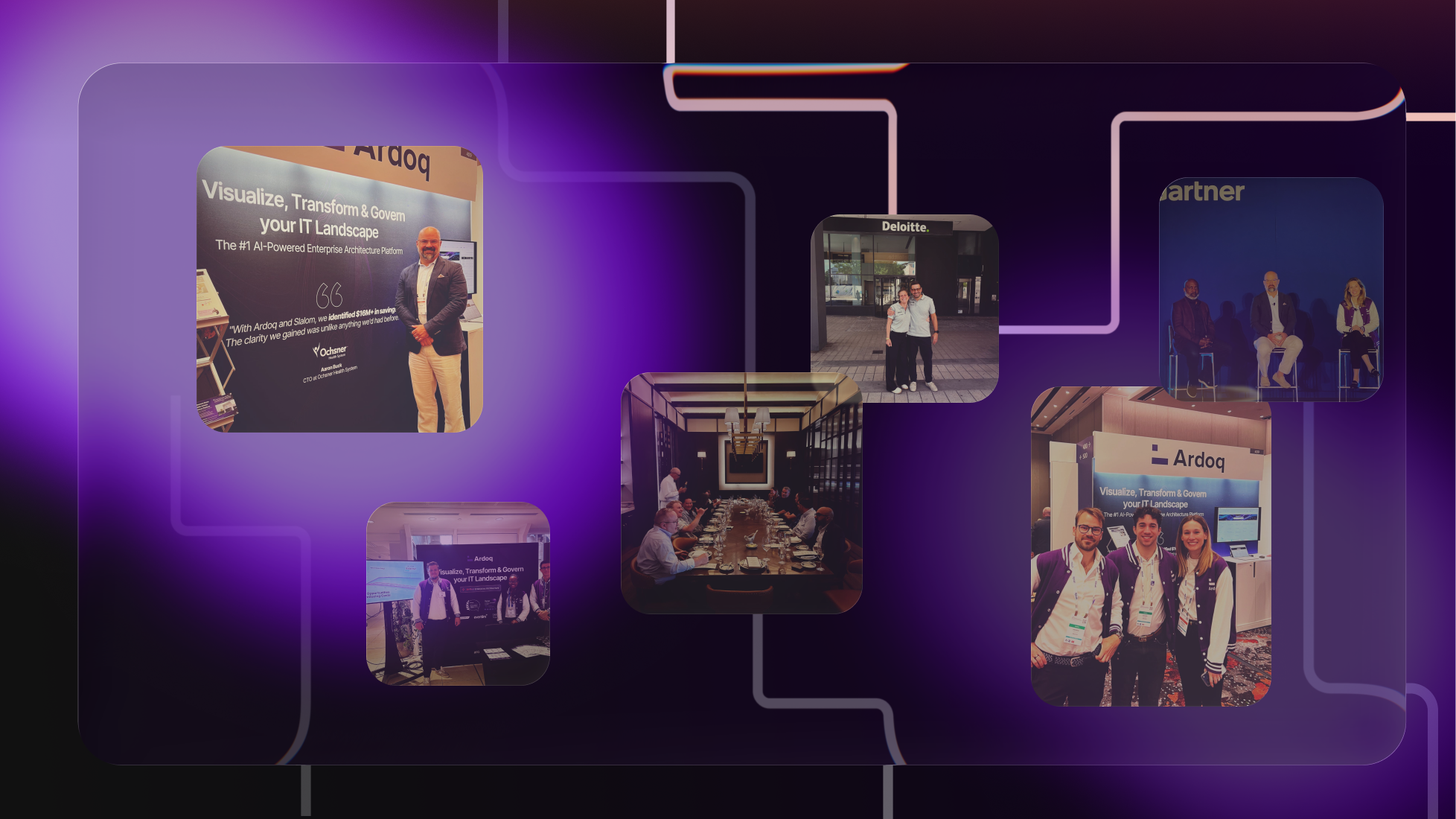
None of this happened in an isolated boardroom in Oslo. It happens because our customers keep showing up, telling us what is broken, and holding us to a higher standard, and because we made a point this quarter of showing up in person, on your terms, in your city.
That started with our Customer Advisory Boards in London and Detroit. Thank you to everyone who joined us. The conversations were candid, occasionally uncomfortable, and exactly what we needed. You pushed us on AI governance, on shadow AI sprawl, on data quality, and on what "trust" actually has to mean when a board is signing off on a major transformation based on what your architecture graph tells them. Several product decisions this quarter trace directly back to those rooms, and more are already shaping what ships next.
We carried that same energy onto the stage. At the Gartner Application Innovation & Business Solutions Summit in Las Vegas, our AI-first Enterprise Architecture session, co-hosted with Ochsner Health and Slalom, drew one of the strongest crowds in the room, a clear signal that IT leaders want practical answers on AI governance, not theoretical ones. Days later, we were back in Las Vegas for Info-Tech LIVE, where thousands of CIOs and CISOs wrestled with the same question we hear everywhere: how do you turn agentic AI from hype into enterprise value? Our answer has not changed. You start with a foundation you can trust.
We also made Ardoq easier to work in, wherever you are. This quarter, we launched Ardoq in German and French, giving teams across Germany, France, Belgium, and Switzerland a native experience instead of a translated one. Through our new partnership with Kapish, we extended dedicated support and delivery expertise across Australia and the wider Asia-Pacific region, meeting the needs of a growing customer base there with local depth rather than a satellite team.
All of that activity is compounding. We welcomed a steady wave of new customers this quarter, continuing the growth we saw in Q1, and closed the first half of 2026 as a Gartner Peer Insights Customers' Choice, with the highest willingness-to-recommend score in the market. That recognition belongs to the architects and IT leaders using Ardoq every day, not to us. We are simply the platform lucky enough to be trusted with the work.
The Great Migration Is Real
The third theme of the quarter is the one I am proudest of, because it validates a bet we made years ago: independence wins.
In April, we launched the Free Your IT movement because we kept hearing the same complaint from CIOs and Enterprise Architects: when one vendor controls both your infrastructure and your ability to audit it, that vendor owns your roadmap, not you. They decide when you migrate, what counts as modernization, and how much blind-spot tax you pay for the privilege.
We are seeing organizations reject that trade-off in real, measurable ways. Composable architecture, not suite lock-in, is now the default posture for IT leaders rebuilding their stacks for the AI era, and analysts expect most enterprises to run multi-vendor architectures to orchestrate AI agents rather than betting everything on one provider. You cannot manage that kind of composable, multi-vendor estate from inside the walled garden of the very vendor you are trying to get visibility over. You need an independent ground truth that sits above every platform, every cloud, and every legacy system you run, one that has no commercial incentive to steer you toward its own stack.
We are watching the same pattern repeat itself one layer up, in the choice of LLM itself. The ecosystems that bundle a foundation model into every layer of their stack have every incentive to steer your next architectural decision toward their own model, whether or not it is the best model for that job. That is not a reason to distrust AI. It is a reason to make sure the platform reasoning on your architecture is not the same platform selling you the model. It is why we designed Ardoq to be model-agnostic: we choose the best model for each task on cost, latency, and privacy grounds, and we will keep making that choice independently as the market shifts, rather than asking you to bet your architecture on whichever model we happen to have a commercial relationship with.
That is the case Ardoq has been making since 2013, and it is why we are seeing what I can only call a mass migration: organizations trading static documentation, and the vendors who profit from keeping it static, for a connected, independent view of their entire enterprise. New customers are arriving from legacy platforms every week. They are not just switching tools. They are reclaiming a roadmap that was never really theirs to begin with.
What This Means for the Rest of 2026
Three threads, one conclusion: the organizations that win the next phase of the AI era will be the ones with an accurate, governed, independent map of how their business actually works, and the discipline to keep it that way.
We built Ardoq to be that map. Thirteen years in, and after a quarter like this one, that mission has never felt more necessary, or more validated.
Thank you to every customer, partner, and Enterprise Architect who joined us in a room this quarter, challenged us, and trusted us with your architecture. We are just getting started.
/Logos/Ardoq/RGB_Ardoq_Logo_Stacked_White_Monochrome%201.png?width=80&height=77&name=RGB_Ardoq_Logo_Stacked_White_Monochrome%201.png)