/Logos/Ardoq/RGB_Ardoq_Logo_Primary_Purple.svg)
There is a growing question taking hold in technology circles these days: Can’t we just use AI to build all these expensive SaaS tools instead of buying them all the time?
It is an understandable question. In the context of Enterprise Architecture (EA), AI is already demonstrating an ability to accelerate tasks that once required significant manual effort and niche technical skills. It can summarize large datasets, suggest data relationships, conduct basic impact analysis, and even generate models from unstructured inputs.
But this line of thinking confuses activity with outcome. There's a big difference between building something and owning something. And that distinction is where most "build vs. buy" conversations go wrong.
The Real Decision Isn't Build vs. Buy. It's Which Kind of Costs Your Organization Is Going to Bear.
When organizations consider using AI tools instead of a purpose-built EA platform, they often frame it as "build vs. buy." But that framing is incomplete.
DIY AI is not free. It's a different kind of purchase — building your own solution means the true cost is hidden in engineering time, maintenance cycles, and long-term ownership instead of a license fee.
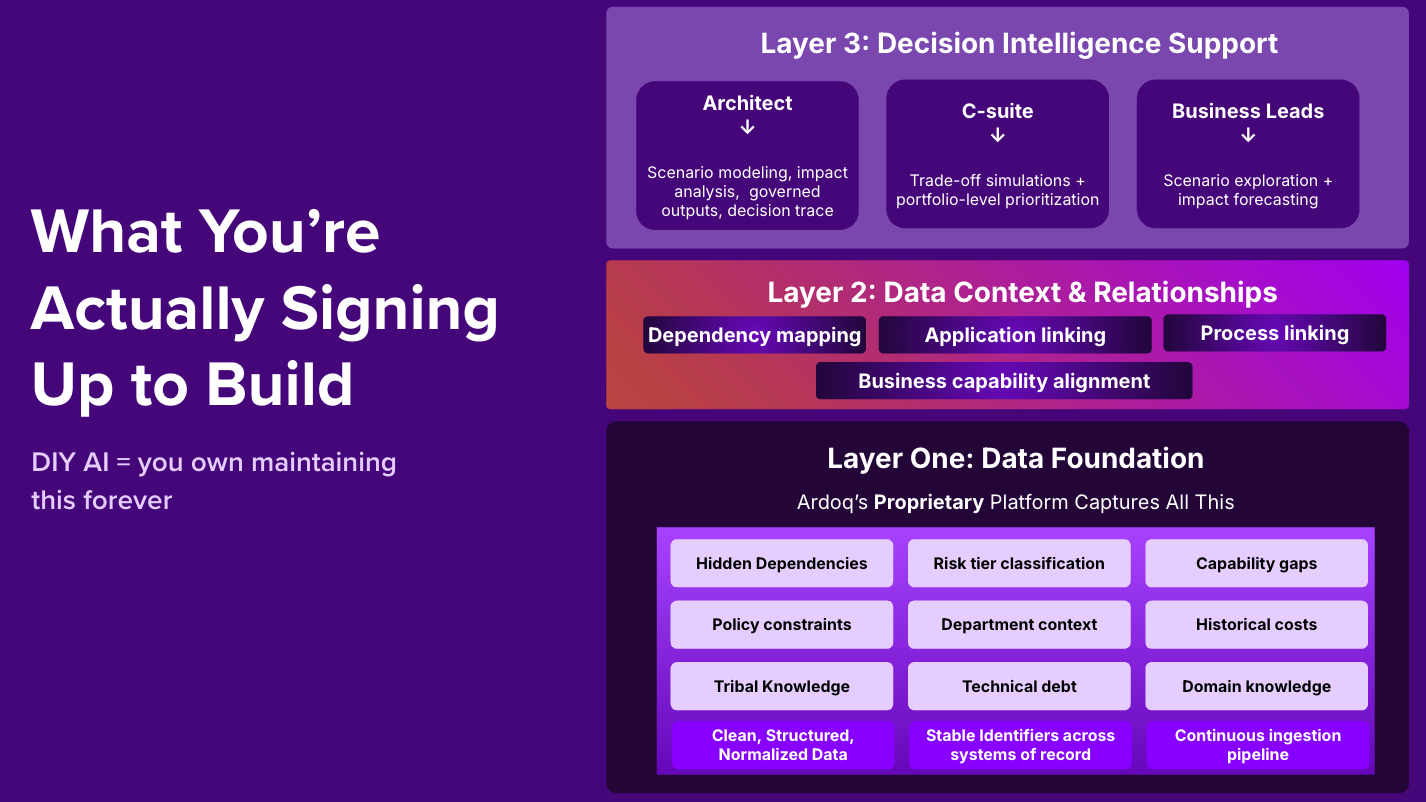
If you build internally, you're not just building a tool. You're creating a platform that your organization will depend on. That platform needs to be maintained, evolved, secured, and supported. It needs governance. It needs to handle the complexity of real enterprise data at real enterprise scale. It needs to be usable by architects, IT leaders, and business stakeholders — not just the person who built it.
The question isn't whether to spend. It's what you're choosing to spend on.
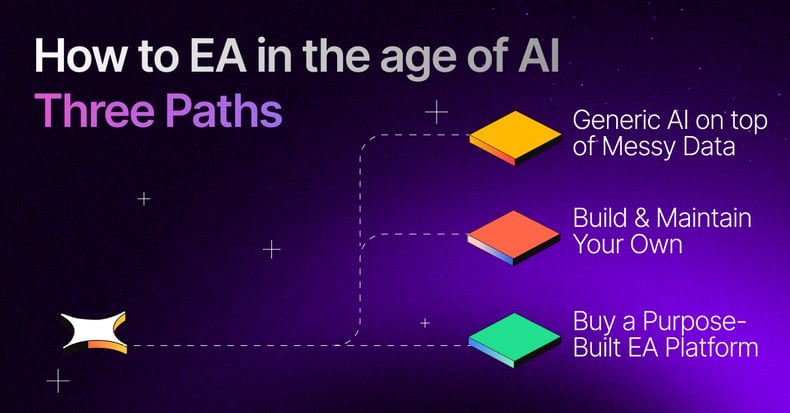
The three paths we see most often:
-
Path 1: AI on top of existing data (Claude, Copilot, or similar tools layered over spreadsheets and existing systems). Fast to start and very flexible. Seems to work well for individual use and quick questions. The challenge is that it amplifies whatever's underneath — which means inconsistent data produces inconsistent outputs, and those outputs compound over time.
-
Path 2: Build your own (A custom-built, AI-powered EA tool). Often starts impressively with a prototype that looks great in a demo. This can work well for the person who built it, but the problem isn't building version 1. It's maintaining versions 2, 3, and 4 while your data model evolves, your team changes, and more of the organization relies on it.
-
Path 3: Buy a purpose-built enterprise-grade EA platform. Requires higher upfront investment and onboarding effort but delivers structured, governed, enterprise-grade architecture capability from day one — built to scale, built to explain its reasoning, and built so that your teams don't become the product team for an internal EA tool.
The question isn't whether your team can build their own tooling because increasingly, they can. The question is whether building and owning an internal EA platform is the best use of your engineering capacity — or whether that effort should go toward the work that actually differentiates your business.
Why Prototypes Look Cheap, and Systems Don't
Here's the pattern we see consistently when teams decide to build their own tooling.
-
Phase 1: The team builds something with AI. It works and looks impressive. It solves a narrow use case well. Everyone is excited.
-
Phase 2: More teams start using it and data inconsistencies surface. Logic has to be rebuilt as priorities change. The person who built it becomes the de facto support desk for a tool they didn't plan to maintain indefinitely.
-
Phase 3: Trust in the output drops and governance gaps emerge. The system becomes hard to explain to a CIO. The team has to make a decision: rebuild on a proper platform, or keep patching something that was never designed to scale.
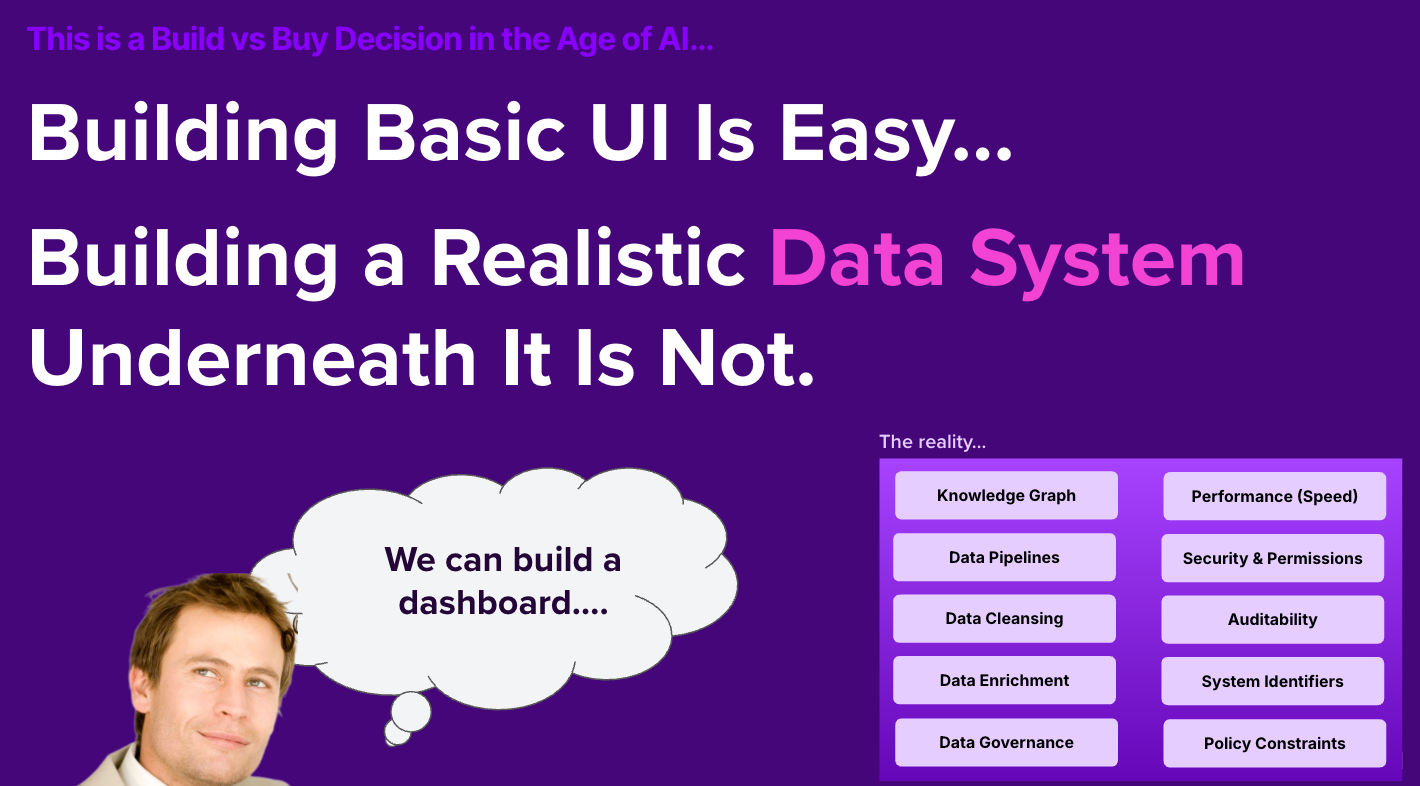
This isn't a failure of effort or intent. It's a structural problem. AI lowers the barrier to starting butt doesn't lower the complexity of what you're trying to build underneath.
The things that break — data governance, dependency reasoning, auditability, consistency across teams, performance at scale — aren't afterthoughts. They're the core of what an Enterprise Architecture platform exists to solve. And they take years to build securely and reliably.
The Problem Isn't Data Collection. It's What Comes After.
One of the most common objections we hear: "We already have all the data. AI can just pull it together when we need it."
Here's the honest response: most organizations do have the data. The challenge is that it's fragmented, inconsistent, and the relationships between things aren't clearly defined. AI can pull it together in the moment — but it doesn't fix those underlying problems. It amplifies them.
A well-designed EA platform doesn't just collect data. It:
- Normalizes and structures data consistently
- Maintains relationships between systems, processes, and capabilities over time
- Validates changes as the organization evolves
- Governs who can trust what and why
- Makes that data reusable for the next decision, and the one after that
An EA platform doesn’t just serve as a visualization layer but a system of truth. Meanwhile "AI on top of messy, unstructured data" is not a system of truth — it's a faster way to surface potentially problematic conclusions.
80% Accuracy Is Not Enterprise-Grade
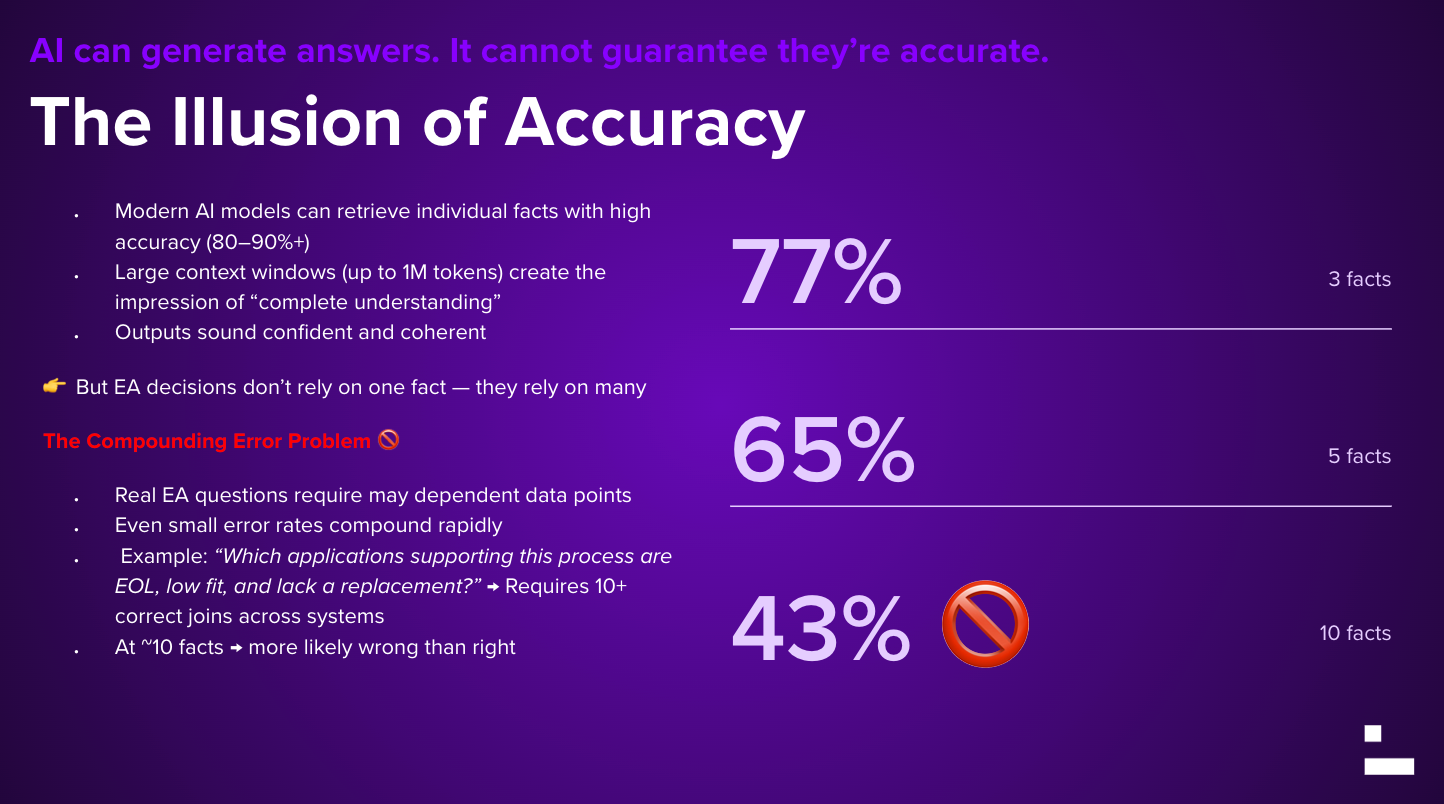
There's a version of this conversation where someone says: "AI gets us 80% of the way there at a fraction of the cost."
That's worth taking seriously — until you ask: 80% accurate in what context?
AI retrieval accuracy degrades with scale and complexity. The more context you add, the more error probability compounds over time. For a quick inventory exercise, 80% might be fine. For decisions about which applications to retire, which dependencies could fail, which changes carry the most risk — 80% accuracy means real exposure.
Enterprise-level decisions need to be defensible. That means consistent outputs across teams and a clear record of what data was used, how it was interpreted, and why a particular recommendation was made. It means the ability to answer — six months after the decision — why you did what you did.
Would you sign off on a decision you can't fully explain? Most CIOs wouldn't. And that's the gap DIY AI consistently fails to close.
App Rationalization Is Just the Entry Point
Another pattern worth naming: over a third of Ardoq customers who start with app rationalization are already solving for additional use cases at the point of sale. That number grows post-implementation.
This matters because "AI can handle app rationalization" is often true for the first questions that arise, such as:
- What are we running?
- What's redundant?
- What should we retire?
However, application rationalization is rarely the endgame. Harder questions follow quickly:
- What changes next, and what are the downstream impacts?
- How do we prioritize across competing initiatives?
- How do we ensure the applications we onboard don't recreate the complexity we just removed?
- How do we keep this data current as the organization evolves?
A one-off AI analysis can answer the first few questions But you need a governed architecture platform to answer all of them — repeatedly, consistently, and in a way that the business can actually rely on.
AI and Architecture Are Stronger Together
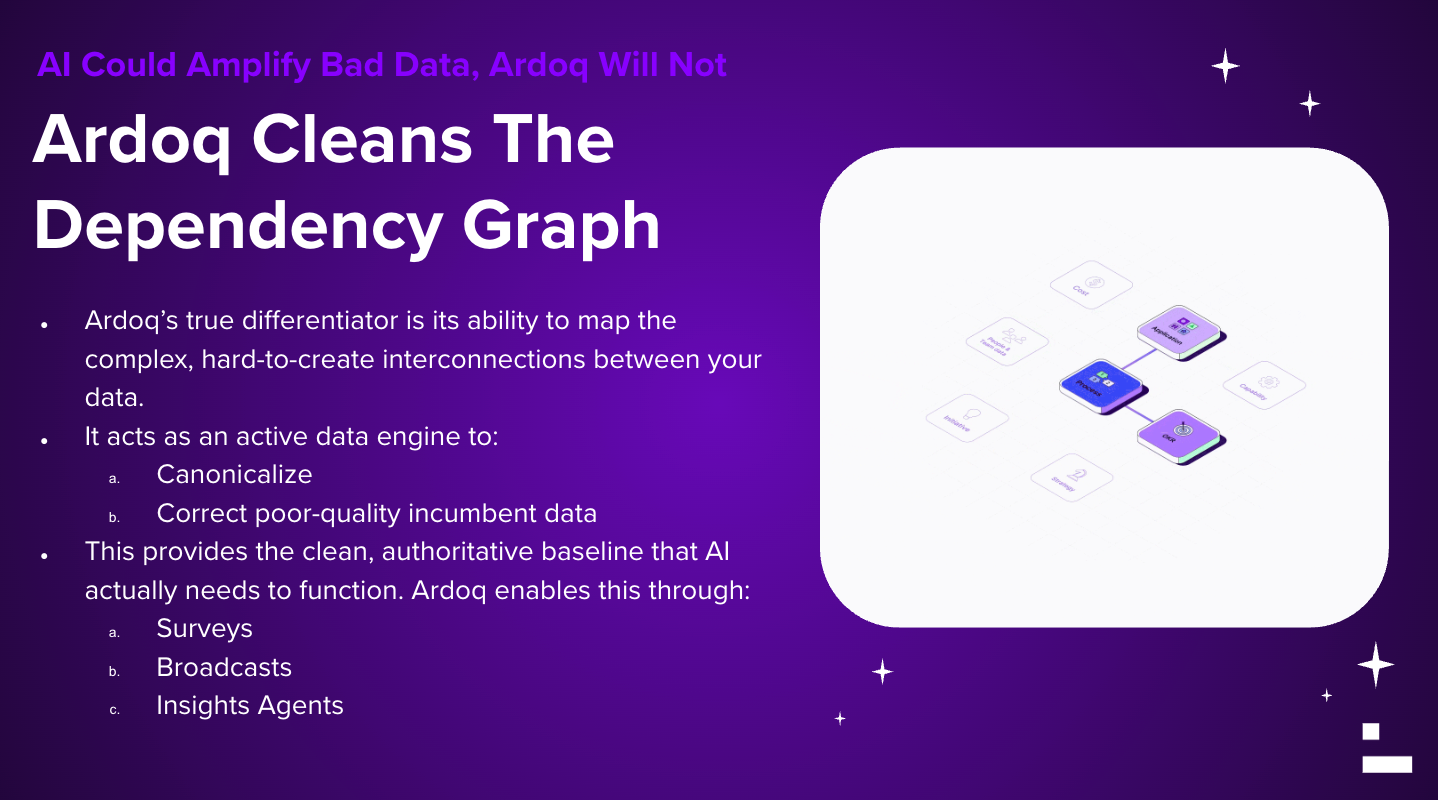
None of this is an argument against AI. Quite the opposite.
AI is genuinely powerful for the things it does well: generating fast visualizations, answering questions quickly, combining data from multiple sources, automating routine tasks. Those capabilities are valuable, and Ardoq is built to leverage them.
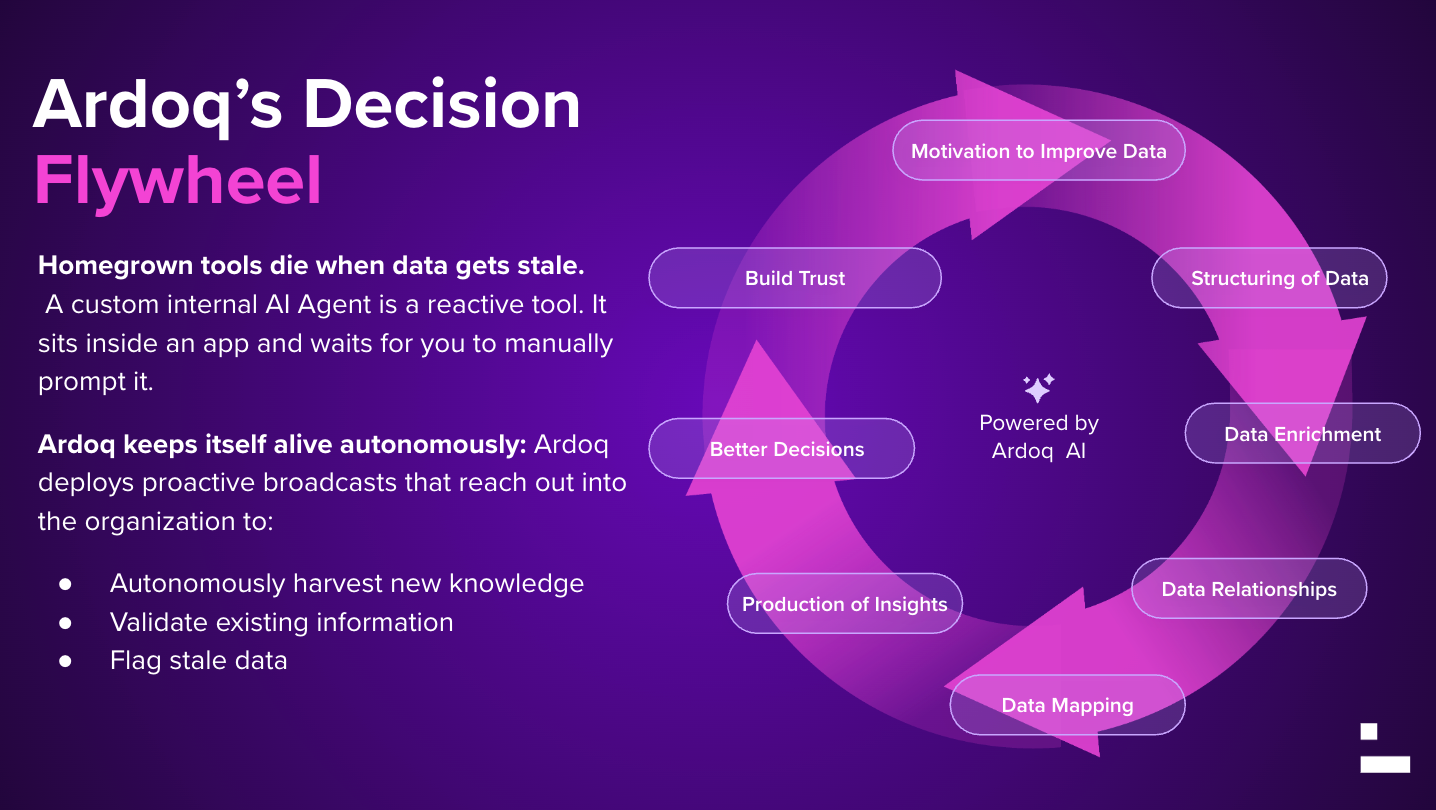
What AI needs to work at enterprise scale is a clean, connected, governed data foundation. Without that, you get fast answers. With it, you get trusted decisions.
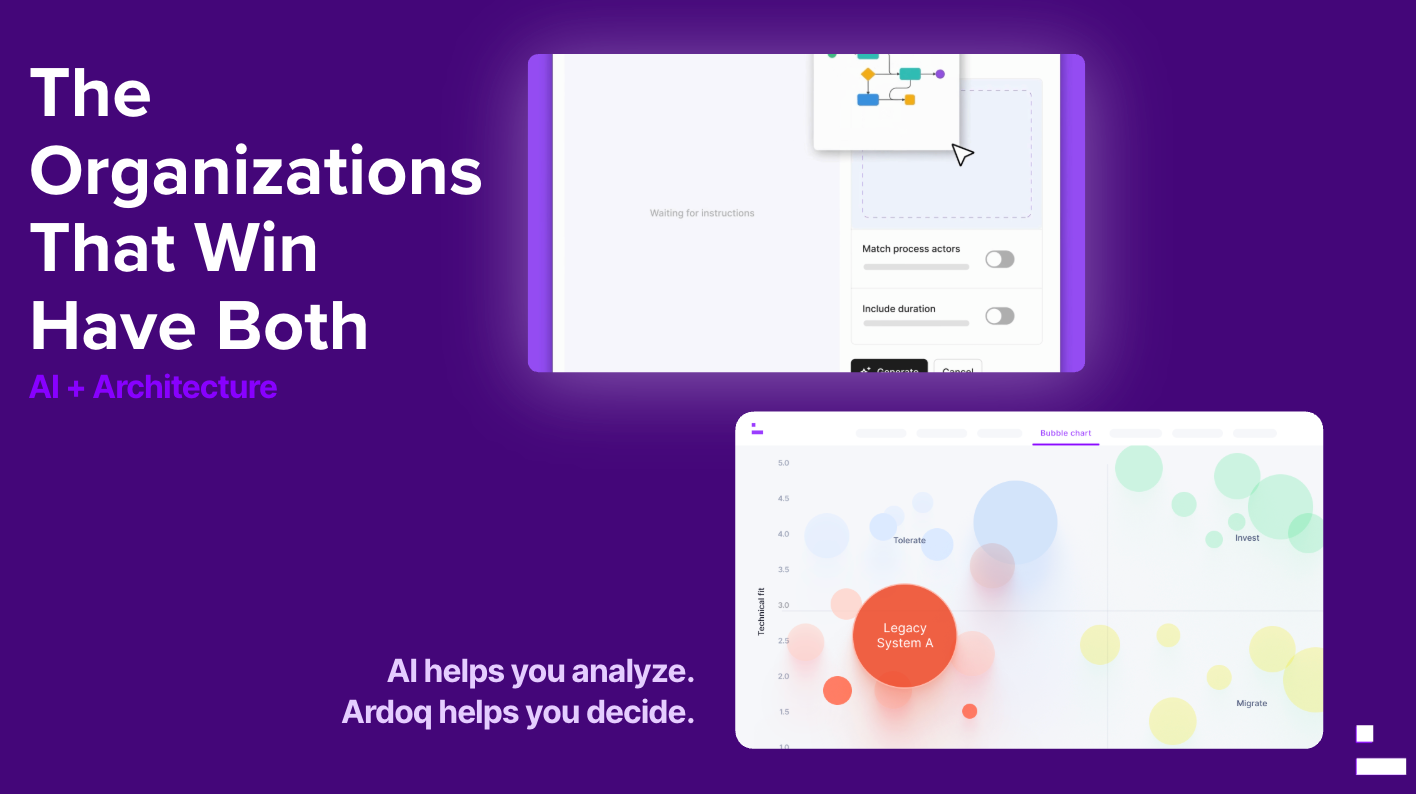
That's the distinction that matters. While AI helps you move faster, a purpose-built architecture platform makes sure you're moving in the right direction.
The organizations getting the most out of AI right now aren't choosing between AI and architecture. They're using both — AI for speed, and a governed system for control, consistency, and decision quality.
The Bottom Line: DIY EA Tooling Bears Higher Risk, Cost, and Resource Than You Think
 Building an internal solution with AI is entirely possible. For experimentation and narrow use cases, it can be the right starting point.
But when the work becomes business-critical — when decisions have consequences, when multiple teams need to trust the same outputs, when a CIO needs to defend a recommendation — you need more than a fast prototype.
You need a system that compounds over time. One that gets more reliable as data improves, not less reliable as complexity grows. One that can explain its reasoning and maintain a clear record of why decisions were made.
That's what Ardoq is built to be.
Not instead of AI. On top of it.
- Blog Posts Innovation Highlights: Ardoq’s 2026 AI Hackathon Q1 AI Roundup: The Next Phase of AI-Powered EA
- Webinars Top 10 AI Capabilities EAs Will Rely on in 2026: Live Demo Edition AI Governance in Practice: How Enterprise Architects Govern AI Agents & Systems with Confidence
- Playbooks Prompt Engineering for Enterprise Architects: The Conversational AI Playbook

/Logos/Ardoq/RGB_Ardoq_Logo_Stacked_White_Monochrome%201.png?width=80&height=77&name=RGB_Ardoq_Logo_Stacked_White_Monochrome%201.png)