/Logos/Ardoq/RGB_Ardoq_Logo_Primary_Purple.svg)
If you are trying to map your modern organization using a spreadsheet or a rigid CMDB, you are fighting a losing battle.
It usually starts simply enough. You open a spreadsheet to track your applications. Then, you add a tab for servers. Then another for business capabilities. Before you know it, you have a Frankensteined document with 20 tabs, broken formulas, and version-control issues.
Spreadsheets and traditional legacy tools are excellent for storing lists of things such as inventories, budgets, and simple transactions. However, enterprises are not just lists of things. They are living, breathing ecosystems of relationships.
Applications rely on servers, business capabilities rely on applications, and people rely on all of it. In a modern enterprise, the connections between assets are often more critical than the assets themselves.
When you try to force these complex, spider-web relationships into the rigid rows and columns of a standard relational database (like SQL), you lose the context. You lose the "why."
This is where a graph database changes the game. It is the engine that powers Ardoq, and it is a technology capable of mirroring the true complexity of a modern business.
In a Nutshell: Why Graph Databases
- Context at Speed: Unlike spreadsheets, graph databases map relationships instantly, allowing you to answer complex "what-if" questions in milliseconds.
- Built for Change: You can modify your data model on the fly to track new assets or metrics without breaking your existing architecture.
- Automated Insight: It turns data into dynamic visual maps automatically, eliminating manual diagramming and preparing your data for AI.
The Core Difference: Filing Cabinets vs. The Human Brain
To understand the value, we have to look briefly at how data is stored.
Think of a traditional relational database (like the one powering your finance system) as a room full of filing cabinets. If you want to link a customer to an invoice, you have to find the customer file, get an ID number, walk over to the invoice cabinet, and search for that ID. In database terms, this is called a "join." It works, but it is slow, rigid, and resource-heavy.
Now, think of a graph database like the human brain. Your brain doesn't store "grandmother" in one file and "cheesecake" in another, requiring a search to link them. The moment you think of one, the connection to the other fires instantly.
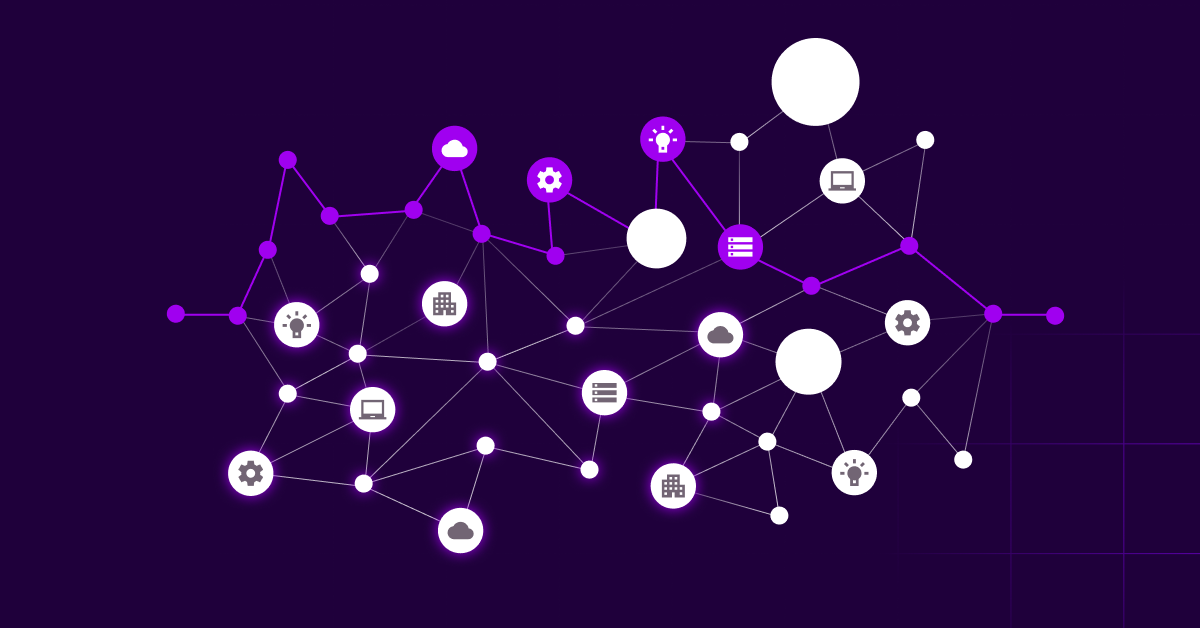 In a graph database, the relationship is a first-class citizen. It stores data as "nodes" (the things) and "edges" (the relationships). This means Ardoq doesn't have to calculate connections every time you ask a question; it already knows them.
Why does this matter to a CIO or an Enterprise Architect? Because it solves four fundamental problems that spreadsheets cannot.
1. It Reveals the "Butterfly Effect" of Change
In a complex IT landscape, a small change in one area can cause catastrophic failures elsewhere. This is the "Butterfly Effect."
In a standard relational database, figuring out these downstream impacts is a nightmare. You have to run complex queries that join multiple tables. As your data grows, these queries get slower and more expensive, often timing out before they give you an answer.
Because graph databases prioritize connections, Ardoq can perform impact analysis in milliseconds, regardless of how much data you have. It allows you to traverse the entire network instantly.
This helps you answer the "So What?" questions that leadership cares about:
- Operational Risk: "If this specific server goes down, which business processes stop? And which revenue streams are threatened?"
- Cost Optimization: "If we retire this legacy application, how much do we actually save on licensing, support, and infrastructure?"
- Change Management: "If we migrate this data center to the cloud, which teams need to be notified, and what compliance standards are triggered?"
Graph technology turns a static inventory into a dynamic decision engine. It moves you from guessing to knowing.
2. It Adapts to Your Business (So You Don’t Have to Rebuild)
Business changes fast. New technologies like Generative AI emerg, regulatory standards shift (like DORA or GDPR, the EU AI Act), and companies reorganize.
Traditional tools often rely on rigid "schemas." A schema is a strict set of rules defining what your database looks like. If you bought a tool five years ago, it probably has a table for "Servers" but no table for "Microservices" or "LLMs.
Graph databases are flexible by design. In Ardoq, you have a flexible enterprise architecture metamodel or map of how your data is organized. The graph structure enables you to modify this map on the fly without breaking your existing data. Need to start tracking "Carbon Footprint" for sustainability reporting? Add it as a property to your applications. Need to map "AI Models" to "Data Privacy Risks"? Create a new component type and connect them.
You can extend your architecture in real-time. This flexibility ensures your EA practice remains relevant as the business evolves, rather than getting stuck in a dated data model.

3. It Stops Death by Manual Diagramming
How much time does your team spend manually drawing diagrams in Visio or PowerPoint? And how long does it take for those diagrams to become outdated? Usually, they are obsolete the moment you hit "Save."
The human brain processes visuals much faster than text. However, manual diagramming is unscalable.
Because graph databases natively understand connections, they excel at automated visualization. Ardoq leverages this to generate dynamic visualizations—Block Diagrams, Relationship View, and Dependency Maps—directly from your data.
- For the Application Owner: You can generate a detailed technical lineage of their specific app.
- For the CFO: You can toggle the view to show a high-level capability map colored by cost.
- For the CISO: You can generate a heatmap of applications with security vulnerabilities.
You aren't drawing these maps. You are querying them. This ensures that stakeholders always see the live reality of the architecture, not an inaccurate drawing from six months ago.
4. It Is the Foundation for AI and Automation
Everyone wants to leverage Artificial Intelligence, but AI is only as good as the data you feed it. Large Language Models (LLMs) thrive on context. If you feed an AI a flat spreadsheet, it struggles to understand how rows relate to one another. However, graph databases are structured around semantic relationships (Subject -> Verb -> Object).
- Application A (Subject) -> Hosts (Verb) -> Data Object B (Object)
This structure is remarkably similar to how LLMs construct knowledge. By using a graph-based tool, you are creating a "Knowledge Graph" of your enterprise.
This allows for:
- Smarter Recommendations: The system can suggest relationships you might have missed.
- Natural Language Questions: You can ask, "Show me all critical business capabilities supported by applications with a low technical health," and the graph structure allows the AI to interpret and fetch that answer accurately.
By choosing graph technology, you aren't just documenting the present; you are structuring your enterprise data to leverage the automation of the future.
Learn more about how the Ardoq platform supports natural language querying: Launching Chat with Ardoq: A Conversational Interface for Your Enterprise Architecture
Real-World Scenarios: Where Graph Wins
So graph databases sound great in theory. Here’s how it plays out in practice when it comes to day-to-day work.
Example: Application Rationalization
You’re tasked to cut IT costs by 10%. A spreadsheet tells you which apps are expensive. A graph database tells you which apps are expensive and redundant. By mapping capabilities to apps, you can see that you have five different tools performing "Project Management." The graph highlights the overlap, allowing you to decommission four of them safely.
Example: Cloud Migration
Your organization is moving to Azure. You need to know not just what to move, but in what order. A graph database reveals the dependencies. You can see that App A feeds data to App B. If you move App B first, you break the link. The graph helps you bundle applications into "move groups" based on their actual technical dependencies, reducing downtime and risk.
For a deeper dive into the benefits of graph databases in EA and how they function: Graph Databases and Enterprise Architecture: A First‑Principles Guide
Summary: The Right Tool for the Job
You wouldn't use a hammer to turn a screw. You shouldn't use a spreadsheet to map an enterprise.
To make smarter decisions, optimize costs, and navigate change, you need a tool that reflects the reality of your complex ecosystem. The world is connected, and your data should be, too.
Ardoq’s graph-based platform gives you the speed, flexibility, and insight to lead your organization forward with confidence.
Ready to stop struggling with spreadsheets and start mapping your future?
- Blog Posts Graph Databases and Enterprise Architecture: A First‑Principles Guide Data-Driven EA: Why Out-of-the-Box Integrations are Non-Negotiable
- Features Ardoq's APIs and Integrations Ardoq Platform Overview

/Logos/Ardoq/RGB_Ardoq_Logo_Stacked_White_Monochrome%201.png?width=80&height=77&name=RGB_Ardoq_Logo_Stacked_White_Monochrome%201.png)