/Logos/Ardoq/RGB_Ardoq_Logo_Primary_Purple.svg)
/Photos/Customers/Ochsner%20Health/OH_OchsnerHealth_Logo_Color_resized.png)

/Logos/Customers/umcg_logo_2025.png)

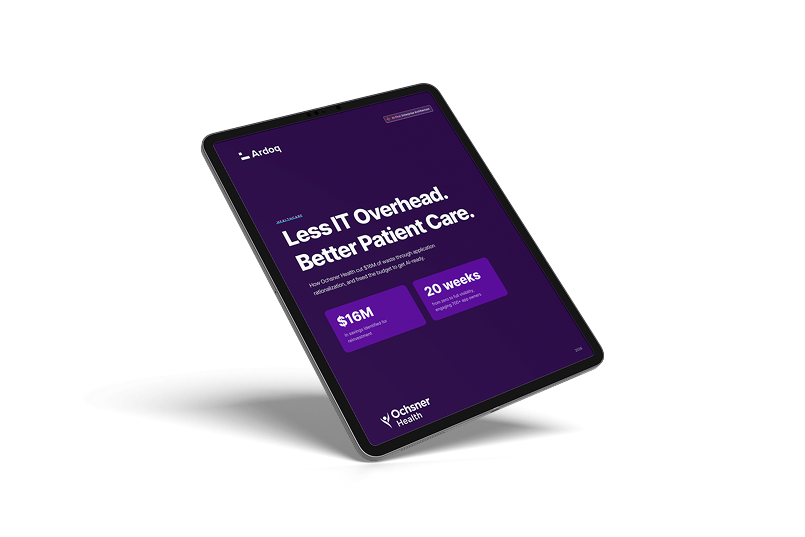


It depends on the size and sprawl of your portfolio, but the savings come from surfacing redundant and duplicated applications and giving leaders the evidence to consolidate. Ochsner identified $16M. Just as important, the capability model lets you take that number to your CFO and board with the business impact attached, not just a line-item cut.
Ochsner went from no EA function at all to a fully mapped landscape in 20 weeks, engaging 700+ application owners along the way. If you already have an EA foundation, that timeline is faster. Our healthcare fast-start model is designed to get you to first value in weeks, not quarters.
No. Ardoq is SaaS, so there's no infrastructure investment required. The main effort is change management: getting application owners to respond to surveys. Ardoq's tooling automates that at scale, and our partner network handles the implementation complexity.
Start with capabilities, a shared model that gives both organizations a common language before you touch anything. Once capabilities are mapped, you can layer on applications, costs, and owners from each entity. That's what shows you what to consolidate, what to keep, and what to retire, and in what order, so you maximize ROI without disrupting clinical operations.
A CMDB tells you what exists; it doesn't connect cost, ownership, and business value, or stay current on its own. Ardoq integrates with sources like ServiceNow and your existing systems to pull that data in and keep the picture live, then maps it to the capabilities and care it supports.
Yes, and that's the point. The model is built to speak to a chief medical officer as readily as the IS team, with role-appropriate views so stakeholders see what matters to them without learning EA notation. That shared picture is what gets IT and clinical leadership making decisions from the same source of truth.
You can't govern AI you can't see. Ardoq maps your full application landscape, including what data each system holds, before you deploy anything. Ardoq's AI Lens then gives ongoing visibility into where AI is running, what it touches, and what controls are in place. That's what responsible AI adoption looks like in a regulated environment.
Yes. Ardoq is used by countless global public-sector organizations including the Washington State Department of Ecology, CalPERS, Oregon State Lottery, and multiple government agencies across the U.S. and Canada.
Yes. Ardoq meets enterprise-level security requirements and supports secure, role-based data sharing. Data shared for statewide reporting is limited to standardized fields controlled by agencies.
Yes. Ardoq has local data centers in both regions and can offer this upon request.
/Logos/Ardoq/RGB_Ardoq_Logo_Stacked_White_Monochrome%201.png?width=80&height=77&name=RGB_Ardoq_Logo_Stacked_White_Monochrome%201.png)